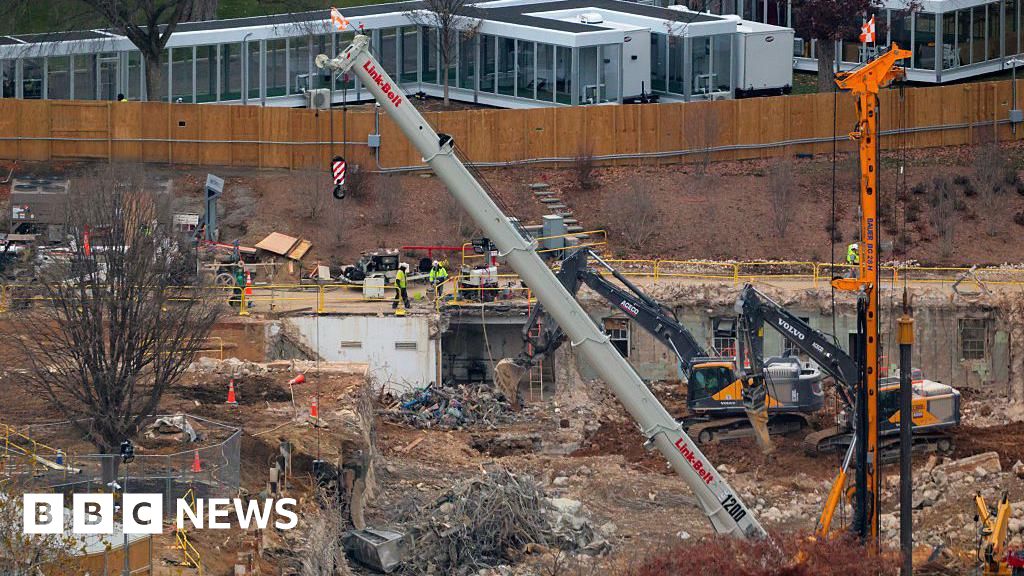
The DOJ is seeking to lift a judge’s pause on Donald Trump’s proposed $400 million White House ballroom after the weekend shooting at the Washington Hilton, arguing the project’s security features justify moving ahead. Preservationists, led by the National Trust for Historic Preservation, say Trump lacked authority to start the project without congressional and agency approvals and are continuing the lawsuit. The article is primarily a legal and political dispute with limited direct market impact.
This is less about the ballroom itself than about how a security-cum-symbolic justification can be used to reframe a discretionary real-estate project into a quasi-infrastructure necessity. That matters because once the administration leans on public safety language, the litigation stops being a narrow preservation dispute and becomes a referendum on executive process, raising the probability of procedural delays, injunction churn, and higher soft costs over the next 1-3 months. The market implication is not for one clean headline, but for a prolonged path dependency where every legal filing or security incident can be used to extend the timeline.
Second-order beneficiaries are more likely to be contractors, security systems vendors, and adjacent federal services than the project sponsor itself. If the project survives, the political incentive is to over-engineer the site with hardening, access control, and command-and-control layers, which can lift final capex well above the initial budget and shift spend toward defense-adjacent integrators rather than traditional construction names. That creates a subtle rotation from pure civil works into secure facilities, perimeter tech, and federal compliance consulting over a 6-18 month horizon.
The bigger risk is not legal loss, but reputational overreach: if the administration is seen as exploiting a recent security event to justify unrelated construction, a judge may become even less receptive to emergency-style arguments. Conversely, if the case stalls and the East Wing site remains dormant, the market gets a negative signal on federal project permitting discipline, which could modestly weigh on sentiment for non-defense commercial real estate redevelopment with politically sensitive approvals. The contrarian view is that the obvious headline bearishness is overdone for listed markets; this is primarily a process story, and process risk usually creates optionality for vendors with government exposure rather than broad beta downside.
AI-powered research, real-time alerts, and portfolio analytics for institutional investors.
Request DemoOverall Sentiment
mildly negative
Sentiment Score
-0.15
