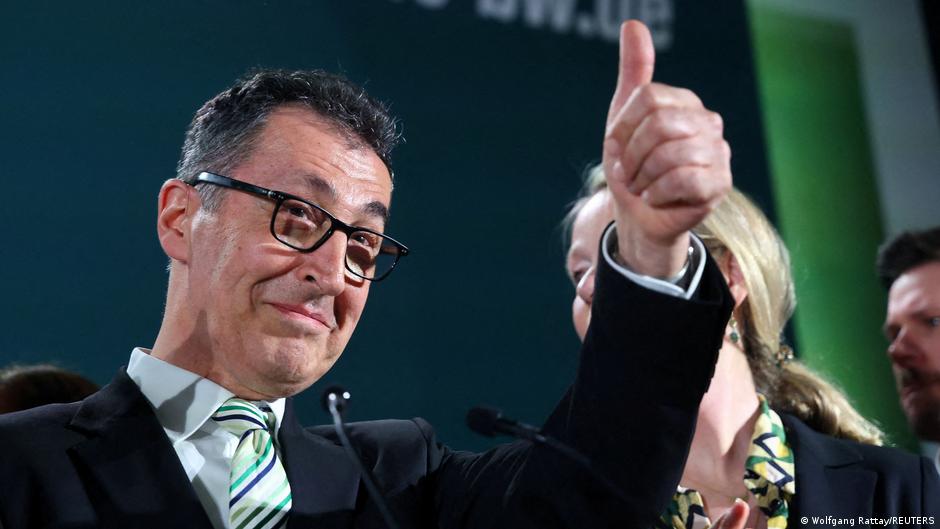
Greens won Baden-Württemberg with 30.2% vs CDU 29.7%; Cem Özdemir is set to become state premier and would be Germany's first state premier of Turkish heritage. Far-right AfD surged to 18.8% while SPD plunged to 5.5%; FDP and the Left missed the 5% threshold at 4.4%, prompting senior resignations. Separately, a meteorite fragment breached a roof in Koblenz (no injuries), an isolated natural-phenomenon incident with limited economic implications.
Baden‑Württemberg’s political shift is best read as a policy inflection for industrial policy and permitting rather than a pure electoral novelty. Expect an acceleration of electrification, charging infrastructure and distributed renewables permitting at the state level over 12–36 months — projects that translate into capex and long‑duration revenue streams for grid operators, industrial automation and engineering suppliers.
The immediate market reaction will be muted: coalition continuity with the CDU reduces the probability of sudden regulatory shock, but the AfD’s stronger showing increases policy tail‑risk around migration and social spending, which could crowd out investment if it escalates at the federal level. Key catalysts to watch are the coalition treaty (1–3 months), the state budget process (3–9 months) and how Baden‑Württemberg allocates EU cohesion/green transition funds — each will materially change the phasing of projects.
Second‑order winners are not just renewables generators but firms selling onshore grid upgrades, high‑power charging hardware and industrial software for energy management; losers are businesses exposed to lengthy land‑use disputes (large footprint brownfield expansions) and any local contractors overly dependent on fossil‑fuel permitting. FX and sovereign risk channels matter: a credible green capex wave would be euro‑supportive versus the dollar over 6–18 months as Germany’s investment profile improves, but a stalled coalition or federal friction could reverse that quickly.
The consensus will frame this as a symbolic win; the contrarian read is that policy continuity plus targeted green acceleration creates a multi‑year sectoral re‑rating opportunity for specific capex beneficiaries rather than a market‑wide political risk premium. Position sizing should reflect a binary set of catalysts (coalition treaty, state budget) within the next 90–270 days rather than headline noise from single‑day price moves.
AI-powered research, real-time alerts, and portfolio analytics for institutional investors.
Request DemoOverall Sentiment
neutral
Sentiment Score
0.00
