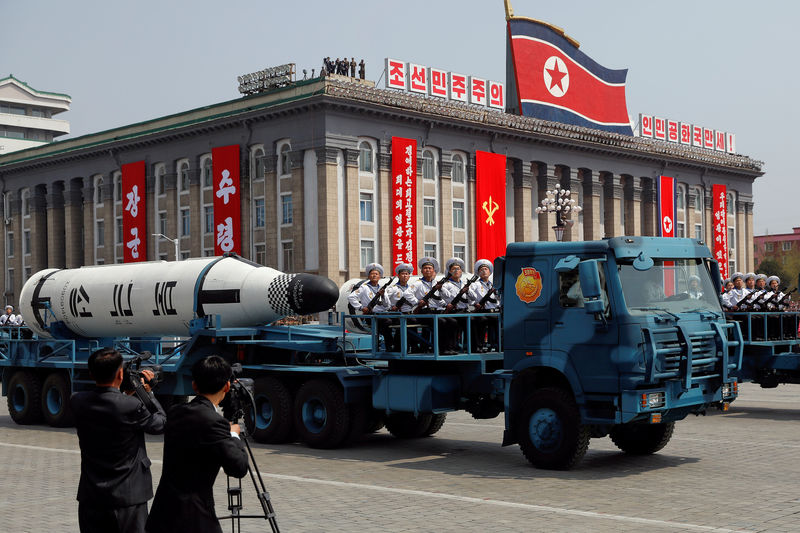
North Korea launched an unidentified ballistic missile on Saturday, adding to a recent series of tests including short-range launches on April 8. The escalation comes as the U.S. shifts military resources to the Middle East amid the Iran conflict, raising geopolitical risk and reinforcing concerns about Strait of Hormuz disruption, energy-price volatility, and broader supply-chain stress.
The market is still underpricing how quickly a second conflict theater can translate into tighter risk premia across energy, shipping, and defense. The key second-order effect is not the launch itself, but the signaling: when multiple adversaries test U.S. bandwidth simultaneously, the probability of policy error, miscalculation, or overreaction rises nonlinearly. That tends to widen spreads in freight-sensitive and fuel-intensive sectors before it shows up in headline commodity prices.
The near-term winner set is defensive and capacity-constrained industries with direct exposure to elevated geopolitical spend: missile defense, electronic warfare, hardened communications, and select offshore security/logistics names. The loser set is broader than airlines and transport; it includes chemicals, industrials with globally sourced inputs, and cyclicals dependent on stable Asia-Middle East routing. If the Strait of Hormuz remains a live risk, even a modest insurance-cost increase can force working-capital drag and margin compression for import-dependent businesses within one quarter.
The real catalyst window is days to weeks, not months: each additional provocation increases the odds of U.S. force posture changes, which can amplify energy volatility regardless of actual supply interruption. The contrarian point is that markets often fade these headlines until there is a shipping or refinery disruption, so the first move can be misleadingly small; the bigger move usually comes when option markets reprice tail risk, not when spot prices first react. If diplomacy stabilizes the regional backdrop, the setup can unwind quickly, but absent that, the asymmetry favors owning convexity over direction.
Consensus may be missing that this is a volatility regime shift rather than a single-event story. Even if crude does not spike materially, higher implied volatility can be monetized across energy, freight, and defense via options, while cash equity winners may lag the first order move. The risk/reward is best expressed with limited premium outlays rather than outright beta exposure.
AI-powered research, real-time alerts, and portfolio analytics for institutional investors.
Request DemoOverall Sentiment
moderately negative
Sentiment Score
-0.45
