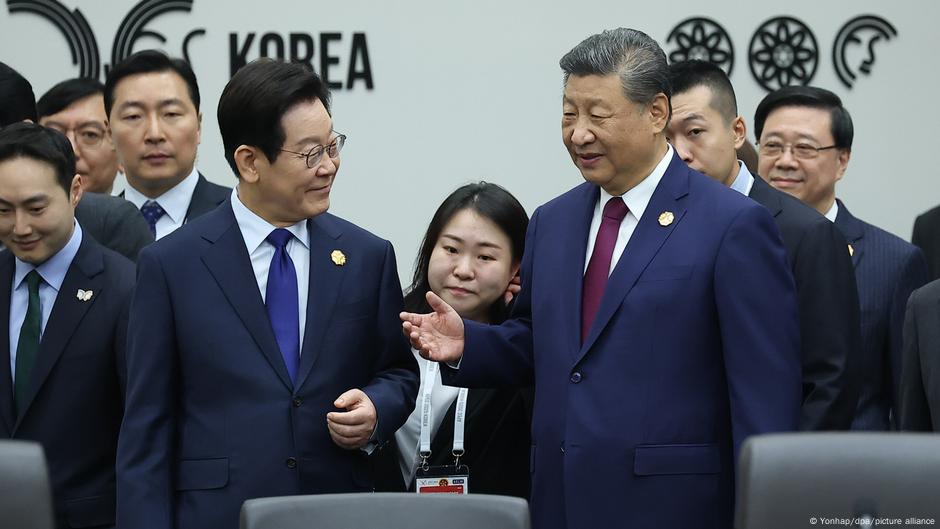
At the APEC summit, Chinese President Xi Jinping advocated for multilateral trade and deeper economic cooperation, positioning China as a defender of free trade despite its past use of export controls, while the U.S. and China reached a tariff truce involving reduced U.S. tariffs for eased Chinese rare earth restrictions. This development, alongside President Trump's early departure from the summit, highlighted the ongoing global economic uncertainty and the complex, evolving dynamics of international trade relations among Pacific Rim economies.
The APEC summit highlighted China's strategic positioning as a defender of multilateral trade and deeper economic cooperation, despite its past use of export controls, notably concerning rare earth minerals. A significant outcome was the US-China tariff truce, where the US agreed to smaller tariffs in exchange for China easing restrictions on rare earth minerals, signaling a potential de-escalation in a key area of trade friction. This development, alongside Chinese President Xi Jinping's call to adhere to the principle of "extending, rather than breaking" supply chains, suggests a nuanced approach to global trade dynamics.
US President Trump's early departure from the summit, leaving Treasury Secretary Bessent to represent the US, underscores the complex and often divergent priorities among APEC members. South Korean President Lee Jae Myung emphasized the critical juncture for the Asia-Pacific region, noting deepening global economic uncertainty and a loss of momentum in trade and investment, stressing that cooperation among APEC members is a "clear solution" to current economic challenges. The APEC region accounts for 50% of global trade and 61% of the world's GDP.
While the immediate tariff truce provides a moderately positive signal, the underlying "cautious" tone and themes like "Geopolitics & War" and "Sanctions & Export Controls" suggest persistent geopolitical competition. China's dual messaging on free trade versus its track record of export controls implies continued strategic ambiguity, which could impact commodity markets and supply chain stability. The meeting between Xi and Canadian PM Carney, signaling positive bilateral development, indicates potential for shifting alliances and trade relationships within the broader geopolitical landscape.
AI-powered research, real-time alerts, and portfolio analytics for institutional investors.
Request DemoOverall Sentiment
moderately positive
Sentiment Score
0.60
