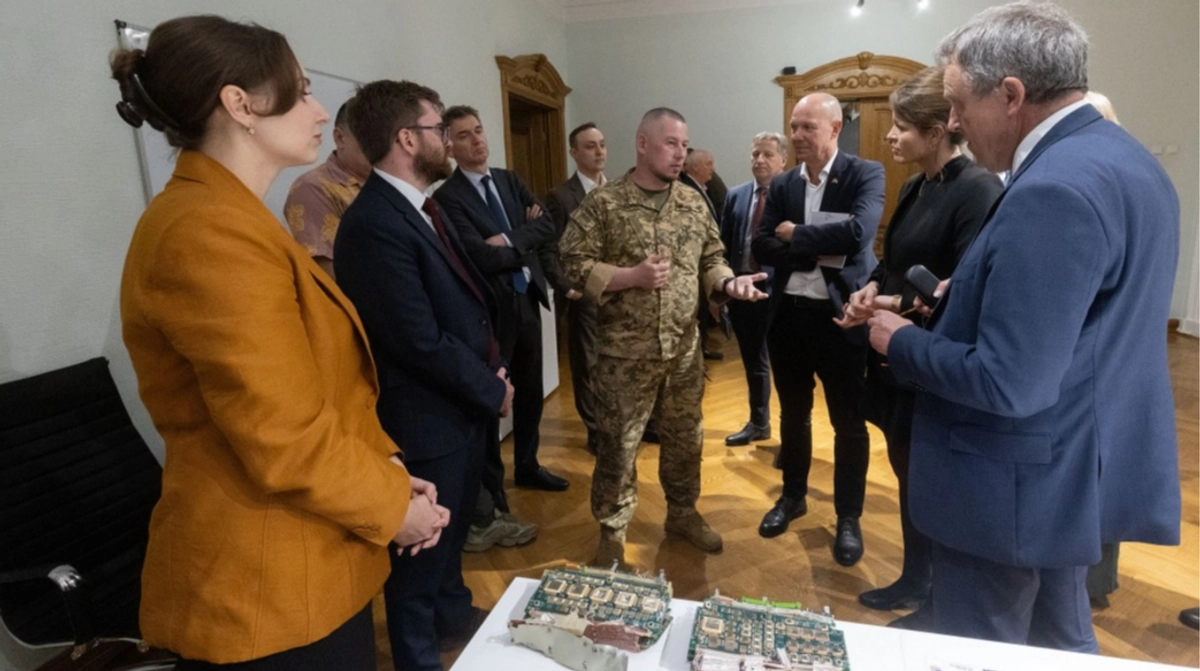
European ambassadors were shown foreign-made components found in Russian Tsirkon, Kalibr, Kh-101 and Geran-2 weapons used in the 23-24 May attacks on Ukraine, underscoring continued sanctions evasion and illicit supply chains. Ukrainian officials said the parts came from suppliers in Switzerland, Germany, the US, the UK, Japan, China and others, while some Oreshnik components were Russian and Belarusian-made. The article calls for tighter export controls, stronger action against Russia's shadow fleet, and greater coordination to cut off electronics and missile component flows.
The market implication is less about the immediate battlefield optics and more about an incremental tightening of the global electronics choke point. If fresh Western-origin parts are still appearing in 2024-25 missiles and drones, the marginal regulatory response is likely to shift from broad sanctions rhetoric to entity-level enforcement, customs screening, and intermediary-country pressure. That creates a second-order hit to the long tail of gray-market distributors, freight forwarders, and small-cap industrial/electronics firms with indirect exposure to dual-use routing through Central Asia, the Caucasus, Turkey, and the UAE.
The more interesting asymmetry is in Belarus. The presence of locally produced boards/chips raises the probability that Belarus becomes treated less as a passive conduit and more as an active sanctions-evasion node. That raises operational risk for firms with Belarusian production footprints or sourcing dependencies, but it also increases the odds of a broader EU compliance squeeze on firms shipping generic components with ambiguous end-use — a negative for high-volume component distributors, a mild positive for firms selling compliance software, trade-screening, and supply-chain traceability tools.
For defense equities, the signal is not new demand so much as higher urgency around interceptors, air defense, and counter-UAS systems. The near-term catalyst is policy: public attribution to European diplomats increases the chance of faster procurement approvals over the next 1-3 months, especially in Europe where inventory replenishment remains thin. The risk to that trade is execution; if enforcement lags and the conflict remains attritional, the spend may stay budgeted but not immediately translate into orders.
Contrarianly, the consensus may overestimate how quickly export-control tightening can meaningfully impair Russian strike capability. The supply chain is fragmented, redundant, and increasingly routed through third countries, so the near-term effect is likely friction and cost inflation rather than a hard stop. That argues for expressing the view through beneficiaries of compliance and defense readiness, not through a blanket short on broad industrial or technology names.
AI-powered research, real-time alerts, and portfolio analytics for institutional investors.
Request DemoOverall Sentiment
strongly negative
Sentiment Score
-0.50
