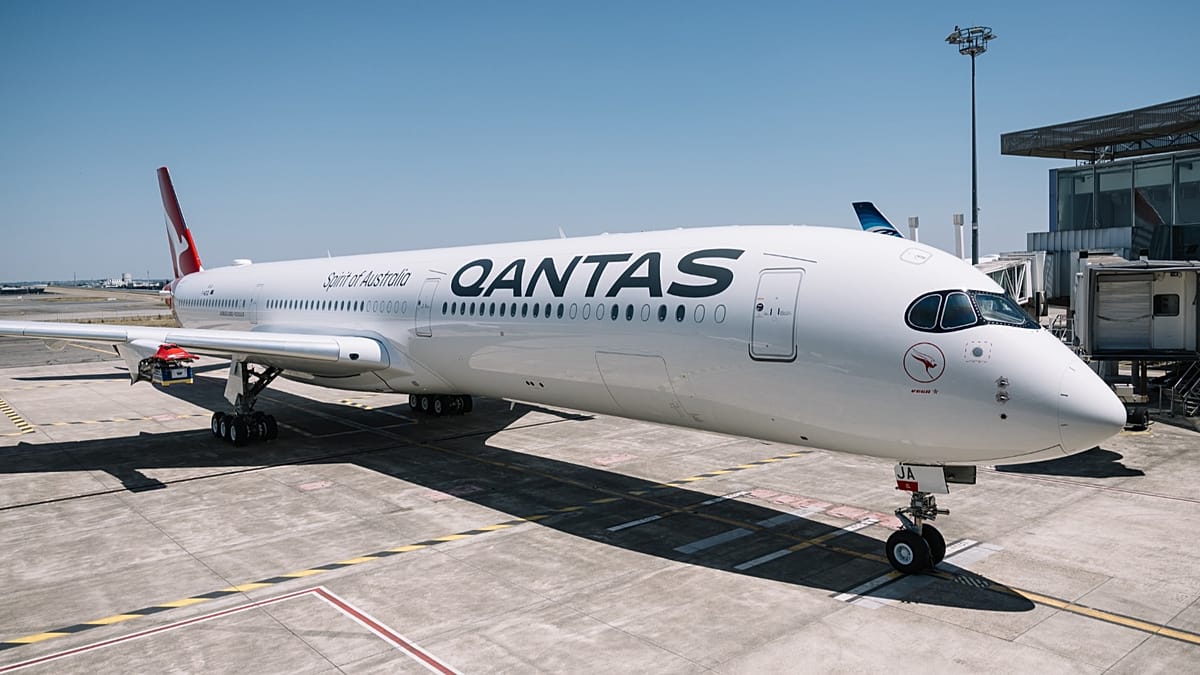
Qantas confirmed Sydney-London as the first Project Sunrise route, with the world's longest non-stop passenger flight set to launch in October 2027 and run 19-22 hours over more than 16,000 kilometres. The airline has unveiled a specially modified Airbus A350-1000ULR configured with 238 seats, including 140 in economy, and will take delivery of 12 aircraft in total. The initiative extends Qantas's long-haul network and reinforces its premium international travel offering, though near-term market impact should be limited.
This is a brand-building event more than an immediate earnings catalyst. The economic logic is less about headline distance and more about what ultra-long-haul converts from a “journey” into a premiumized product architecture: higher yield per seat, stronger corporate contract stickiness, and a structural moat for the carrier that can credibly offer nonstop Australia–Europe/US east coast service. The supply-side implication is important: with only a small number of aircraft and a low-density cabin plan, the route is designed to maximize revenue quality, not volume, which should pressure competitors on premium trunk routes rather than on mass-market traffic.
The second-order winners are not just the airline, but adjacent aviation value chains that benefit from validation of ultra-long-range economics: premium cabin suppliers, maintenance/engineering providers, and airport infrastructure geared toward premium international flows. The biggest loser is any one-stop hub strategy that relies on capturing Australia–Europe connections; nonstop service erodes the value of intermediate hubs by removing schedule risk, immigration friction, and missed-connection penalties. That said, the operational risk is asymmetric: a 19–22 hour product magnifies fatigue, irregular operations, crew utilization costs, and the probability that any early reliability issue gets amplified by social/media scrutiny.
The key contrarian point is that the market may overestimate how much of the value accrues to the airline versus the customer. Ultra-long-haul is a prestige capability, but it is also a narrow niche constrained by willingness to pay, corporate policy, and passenger comfort over repeated travel cycles; the real test is load factor stability in premium cabins, not the first-year PR halo. If fuel or maintenance costs drift higher, the route can remain strategically impressive while being only modestly accretive economically.
From a timing perspective, this is a years-long catalyst path with nearer-term checkpoints in certification, delivery cadence, and the rollout of the second city pair. Any delay, cabin spec compromise, or early reliability incident would matter more to the equity story than the launch date itself. The best trade is likely not directional airline beta, but a relative-value expression on premium aviation exposure versus broader travel cyclicals where the market is already pricing a smoother demand recovery.
AI-powered research, real-time alerts, and portfolio analytics for institutional investors.
Request DemoOverall Sentiment
mildly positive
Sentiment Score
0.35
