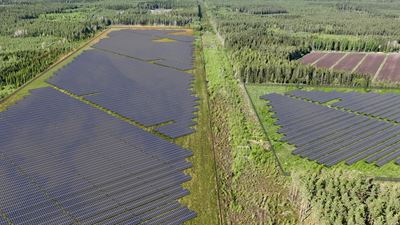
Alight has acquired two large-scale solar projects from Finnish developer 3Flash totalling just over 200 MW (one ~75 MW with an approved 30 MW BESS targeting grid connection ~2028; one ~150 MW planned to connect via a Fingrid substation expansion ~2030), bringing its Finland solar and storage pipeline above 1 GW. The companies will co-develop the sites to ready-to-build status and plan to commercialise output via long-term PPAs; the deal builds on an existing 120 MW + 45 MW BESS Loviisa collaboration which recently won an Innovation Fund grant and uses agrivoltaic/AI technology. The transaction accelerates Alight’s regional build-out ahead of commissioning a 100 MW Eurajoki project this summer and supports its broader goal of at least 5 GW installed capacity by 2030.
Market structure: Alight’s acquisition (ALIT) accelerates utility-scale solar + BESS capacity in low-congestion eastern Finland, creating a regional winner (ALIT/3Flash) and pressuring local merchant thermal peakers by reducing high-margin scarcity hours. Expect incremental downward pressure on peak Nordic power prices in years with high solar output (summer midday), with material local supply additions of ~1 GW in Finland by 2030 shifting short-run scarcity dynamics and compressing spark spreads by an estimated €2–6/MWh in sunny months once >500 MW is online.
Risk assessment: Key tail risks are grid-connection delays (Fingrid timeline slip >12–24 months), PPA counterparty default, and capex inflation for BESS/solar modules; each could defer cash flows and force equity raises. Immediate impact is muted (days); short-term (3–12 months) depends on Eurajoki commissioning this summer and PPA signings; medium/long (1–5 years) hinge on Fingrid substation delivery (~2030) and financing costs (if funding rates rise >200 bps it strains project IRRs).
Trade implications: Direct play is ALIT equity and related solar/BESS suppliers (upstream inverter/ESS makers). Preferred tactic: concentrated small equity position in ALIT with capped option exposure to asymmetric upside around commissioning events; rotate out of merchant thermal utilities (e.g., Fortum FORTUM.HE) and into solar integrators (e.g., SMA S92.DE). Entry: scale into ALIT now to early July ahead of Eurajoki; trim on confirmed ready-to-build milestones (4–12 months).
Contrarian angles: Consensus overweights subsidy narratives; here the commercial PPA-backed approach implies valuation accretion is real but lumpy — market may underprice execution, not demand. Risk of overbuild in a low-load-growth region is real: if industry electrification stalls, realized utilization will be below modelled 1,000–1,400 full-load hours and returns compress. Historic parallel: rapid onshore wind rollouts that rerated developers only after multi-year commissioning success; patience required.
AI-powered research, real-time alerts, and portfolio analytics for institutional investors.
Request DemoOverall Sentiment
moderately positive
Sentiment Score
0.55
Ticker Sentiment
