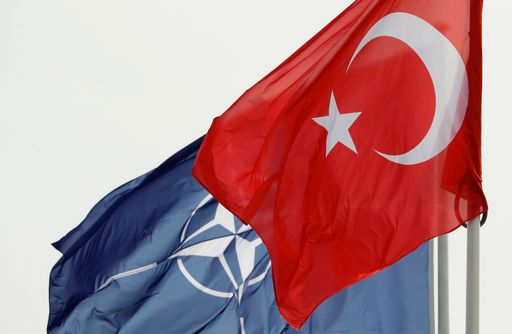
NATO intercepted a third missile fired from Iran toward Türkiye as President Erdogan said keeping Türkiye out of the regional conflict is the government's top priority. Erdogan warned of plots and provocations aimed at dragging the country into war, confirmed Turkey has taken measures to defend its airspace, and urged citizens to guard against sectarian and ethnic tensions. Remarks increase geopolitical risk for Turkish assets and regional stability; monitor potential FX pressure, higher sovereign risk premia, and sensitivity in defense-related sectors.
Türkiye’s public posture — to avoid direct involvement while accelerating agility — creates a classic divergence between political signaling and economic preparation. Expect a near-term fiscal and procurement impulse focused on air defense, ISR, and domestic munitions capacity that will play out over 3–24 months; this is more CAPEX and OPEX for defense primes than a one-off tactical purchase and tends to favor companies with fast delivery cycles and NATO-compatible systems.
A key second-order effect is a potential reorientation away from non-NATO suppliers toward Western platforms: even incremental procurement decisions force multi-year supplier commitments, lengthening lead times and improving pricing power for US/EU primes. Simultaneously, domestic champions in Türkiye’s defense sector stand to win offset contracts and export pipelines, pressuring margins for smaller regional suppliers and boosting regional subcontracting demand for components and electronics.
Domestically, the government’s insistence on avoiding escalation while invoking national unity signals dual-track policy: containment externally, selective stimulus/infrastructure deals internally to shore political capital. That combination tends to produce episodic TRY weakness around shocks, targeted public works awards (benefiting construction and steel over 6–18 months), and limited capital-control tail risk if market stress spikes.
The tactical risk-reward is asymmetric: a contained de-escalation within weeks removes much of the immediate defense bid, while any incident causing casualties or a prolonged NATO operational posture would re-rate defense equities and EM risk premia materially. Watch diplomatic backchannels and tender pipelines as the quickest catalysts that will confirm whether this is procurement-driven repositioning or a transient headline cycle.
AI-powered research, real-time alerts, and portfolio analytics for institutional investors.
Request DemoOverall Sentiment
mildly negative
Sentiment Score
-0.15
