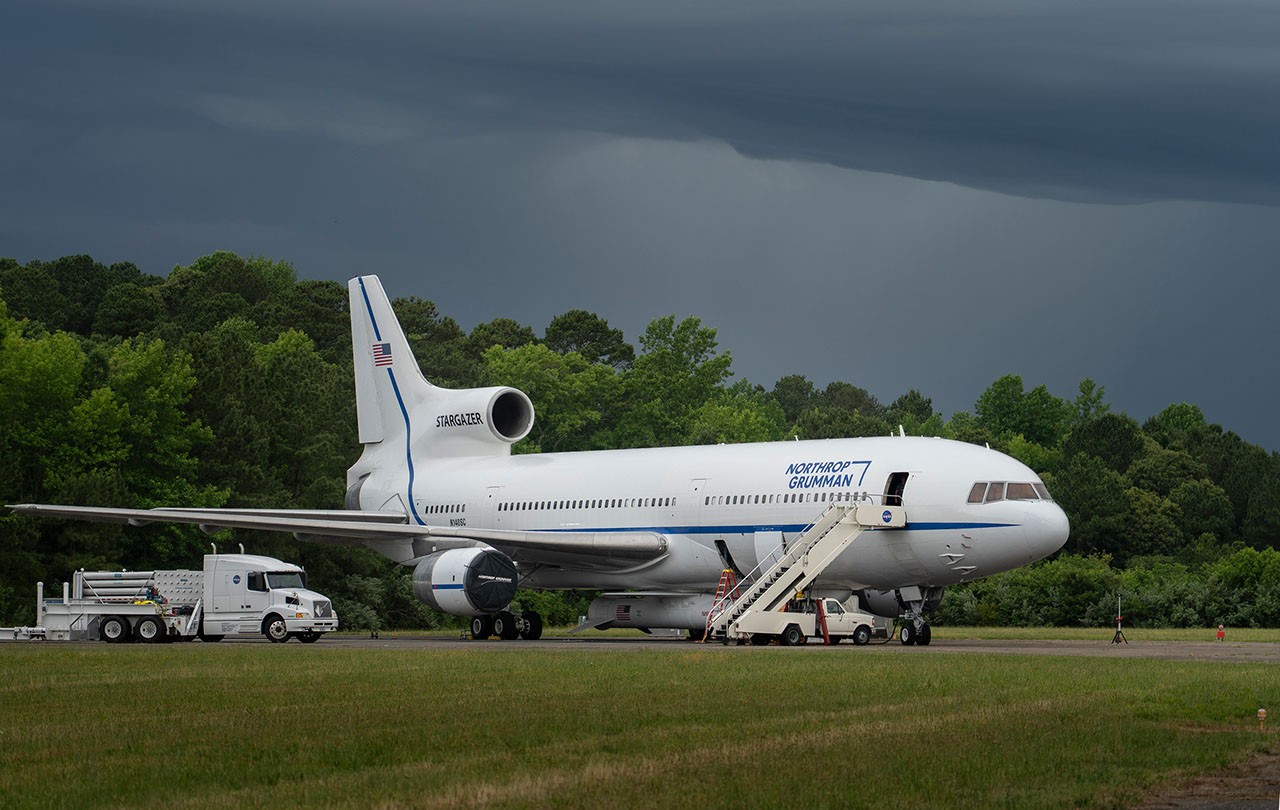
NASA is set to launch the LINK servicing satellite no earlier than June 30 to raise Swift’s orbit and prevent atmospheric re-entry later this year. The mission, contracted to Katalyst Space, is a demonstration of commercial on-orbit servicing using a Pegasus XL rocket and is intended to extend Swift’s lifetime by several months and boost it to nearly 370 miles. The article is operationally important for NASA and the satellite-servicing industry, but it is largely a factual mission update with limited near-term market impact.
This is less a one-off rescue mission than a proof-of-concept for a new commercial maintenance stack in orbit. The near-term economic signal is strongest for the prime integrator: if LINK demonstrates rendezvous, grappling, and controlled orbital modification on a legacy asset, it de-risks a category of services with much larger addressable demand than new satellite launches alone. That creates an option value uplift for companies positioned around in-space logistics, inspection, and life-extension, while also putting pressure on traditional satellite OEMs that rely on replacement cycles as the default answer to obsolescence.
For NOC, the relevance is second-order but real: Pegasus XL becomes more valuable if it can function as a rapid-response, niche access-to-orbit platform for time-sensitive missions that require a narrow window rather than bulk economics. The strategic upside is not launch-market share, but the ability to monetize high-margin, specialized missions where schedule certainty matters more than cost per kilogram. That said, the market should be careful not to extrapolate this into a durable earnings step-up unless Northrop can convert the platform into repeat commercial utilization.
The biggest hidden catalyst is not the launch itself but the post-launch commissioning and rendezvous phase over the next several weeks to months. Failure modes are asymmetric: any anomaly in navigation, capture, or plume interaction would likely reset investor willingness to price in near-term serviceable-space infrastructure, even if the launch succeeds. Conversely, a clean execution could trigger a re-rating of the entire on-orbit servicing sub-sector because it would validate a lower-cost path to extending legacy asset life and delaying replacement capex across civil, defense, and commercial satellites.
The contrarian view is that the market may be overvaluing the symbolic importance of the mission relative to its revenue contribution. This is a capability demonstration with important optionality, not yet a scaled business line, so the equity response could fade if investors do not see follow-on contracts within the next 2-3 quarters. The right framing is to trade this as a technology de-risking event, not as an immediate earnings inflection.
AI-powered research, real-time alerts, and portfolio analytics for institutional investors.
Request DemoOverall Sentiment
mildly positive
Sentiment Score
0.20
Ticker Sentiment
