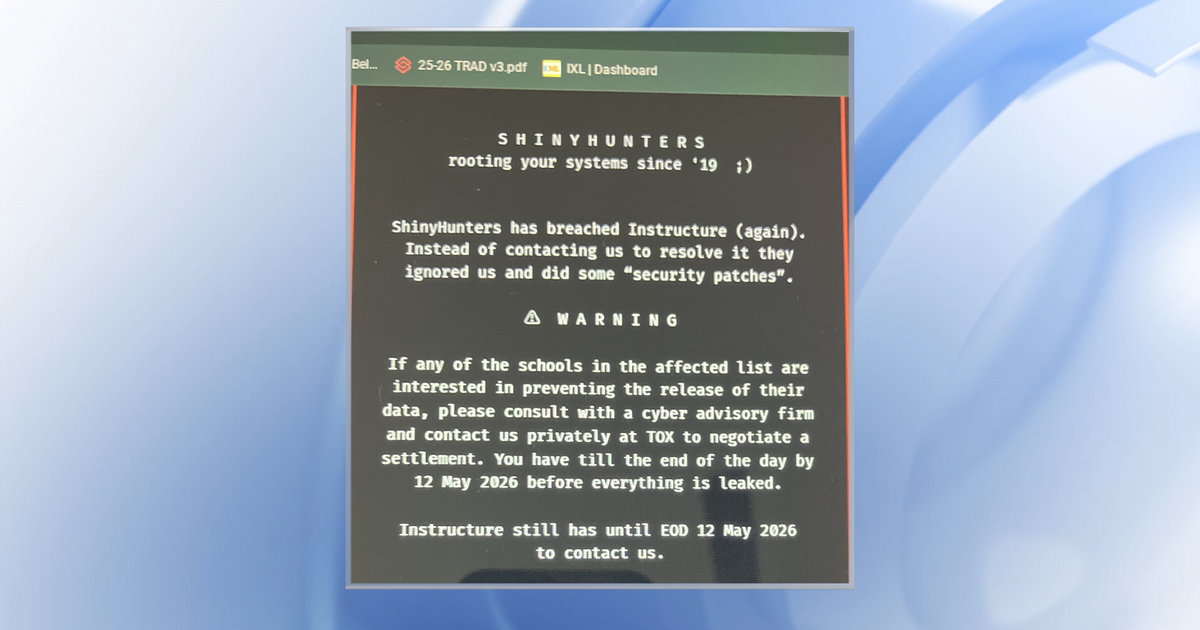
Instructure confirmed a breach affecting Canvas user information tied to schools and universities, with exposed data potentially including names, email addresses, student ID numbers and user messages; the attackers claim data on roughly 275 million users. While passwords, Social Security numbers, financial data and dates of birth were not found compromised, the incident creates significant phishing and identity-theft risk due to the contextual student data involved. The company says it is investigating with outside cybersecurity experts and notifying affected institutions.
This is less a direct monetization event for the named software vendor and more an acceleration of a broader trust shock in K-12 and higher-ed digital workflows. The second-order winner is the security stack around identity, email filtering, MFA, endpoint, and privileged-access controls; once school districts are forced to respond, budgets usually shift from generic IT spend to highly targeted remediation with faster procurement cycles. That creates a near-term demand tailwind for platform vendors that can bundle incident response, phishing defense, and identity hardening into one contract.
The market is likely underestimating how sticky the operational fallout can be. Education buyers are price-sensitive, but a breach that exposes relationship context materially increases phishing conversion rates, which means the remediation cycle can last through the next enrollment and financial-aid periods rather than fading in days. The higher-order risk is liability: expect more class-action, insurance claims, and vendor contract renegotiations, which can pressure margins even if raw user attrition is limited.
For the adjacent public names, the message is mixed. A broad cyber scare is supportive for network and security incumbents with education exposure, but it can also raise scrutiny around their own cloud-hosted data governance and accelerate sales-cycle friction as districts audit every SaaS vendor. For the mentioned ecosystem, the biggest beneficiary may be not the core LMS provider but the breach-response vendors and identity players that become default standards across school systems after procurement reviews.
Contrarian take: the immediate headline risk may be over-discounted in the cyber beneficiaries, because the real spend uplift usually lands with a lag of one to three quarters after incident reporting, board review, and budget approval. Meanwhile, the reputational damage to education SaaS names can persist longer than the security remediation cycle, especially if follow-on disclosures expand the scope of exposed metadata beyond what is initially acknowledged.
AI-powered research, real-time alerts, and portfolio analytics for institutional investors.
Request DemoOverall Sentiment
strongly negative
Sentiment Score
-0.75
Ticker Sentiment
