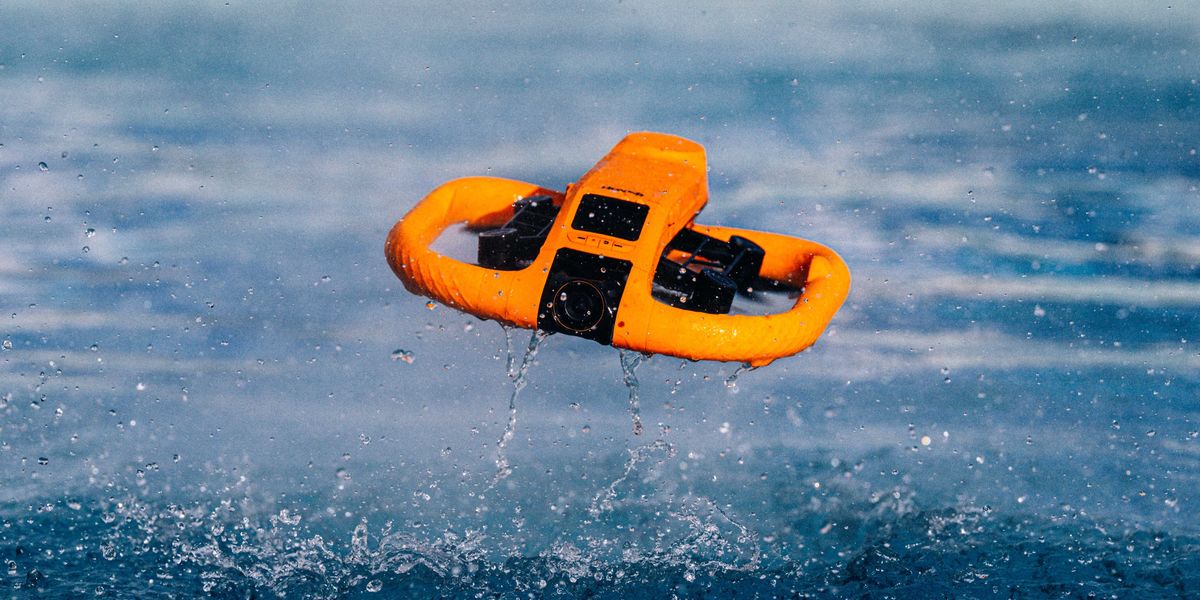
HOVERAir launched the AQUA, the world's first 100% waterproof self-flying camera drone, with 4K video at up to 100 fps, IP67 waterproofing, and a starting price of $1,299. The product is now available globally outside the US, where access appears constrained by the effective ban affecting Chinese drone companies. The news is positive for HOVERAir as a product announcement, but likely has limited broader market impact.
The important signal is not the gadget itself, but the widening gap between consumer drone innovation and US market access. If Chinese-origin aerial imaging products keep getting structurally filtered out of the US, the near-term winners are not obvious drone OEMs but adjacent ecosystems: action-camera incumbents, rugged mounting/accessory makers, and software/workflow providers that monetize creators who still need water-safe capture solutions. The second-order effect is that premium consumer demand may shift from hardware ownership toward integrated capture stacks, which favors firms with distribution and software moats more than low-margin device vendors.
From a competitive standpoint, the product reinforces a bifurcation: “good enough” hardware is becoming commoditized, while regulated market access and trust are becoming the real barriers. That dynamic is bullish for DJI’s non-US footprint only if it can keep expanding internationally, but it also increases the probability that US regulators eventually pull more accessory and component vendors into the orbit of enforcement, pressuring cross-border supply chains and retail channels over the next 6-12 months. The most exposed public-market names are those dependent on consumer drone attach rates, premium hobbyist demand, or creator gear spend without a software layer to offset product cycles.
The contrarian view is that investors may overestimate the revenue opportunity from a niche launch and underestimate substitution. For many creators, a waterproof self-flying drone is a feature, not a category-expanding event; the true demand response may be incremental rather than step-function. If adoption disappoints outside a small enthusiast cohort, the more durable trade is not betting on the drone itself, but on platforms that capture creator workflow dollars regardless of which capture device wins.
Catalyst-wise, watch for any evidence that US restrictions broaden from drones to related imaging hardware, firmware, or component imports. That would be a months-long headline risk, not a days-long trade, and could rerate expectations for consumer robotics more broadly. Conversely, if non-US sales accelerate through summer watersports season, accessory and software attach rates could surprise to the upside in 2H, but that would likely be a selective winner-take-most dynamic rather than a broad beta move.
AI-powered research, real-time alerts, and portfolio analytics for institutional investors.
Request DemoOverall Sentiment
mildly positive
Sentiment Score
0.20
