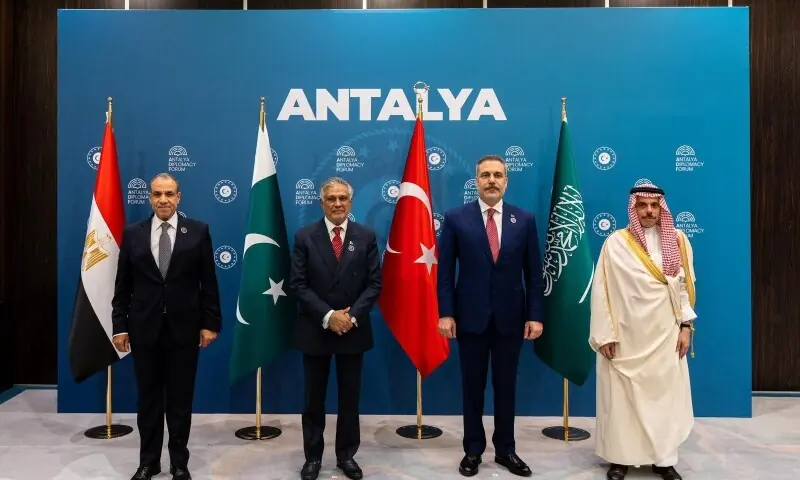
Pakistan, Saudi Arabia, Turkiye and Egypt held coordinated talks on evolving regional dynamics, with the four foreign ministers reaffirming dialogue and diplomacy amid efforts to halt the US-Israeli war on Iran. Egypt said it is working with Pakistan on a framework for lasting peace between the US and Iran, while the regional effort is also aimed at preventing renewed escalation and protecting Gulf states, energy markets, supply chains and food security. The diplomatic activity may help stabilize Middle East risk premia, but no concrete agreement was announced.
The important read-through is that a four-country mediation channel is becoming a parallel diplomatic architecture, which lowers the probability of a one-off ceasefire failure turning into an immediate, uncontrollable escalation. That matters most for markets through volatility compression in Gulf risk premia: even if the underlying conflict remains unresolved, the existence of a backchannel reduces the odds of a sharp jump in shipping insurance, emergency energy hedging, and regional credit spreads over the next 1-3 weeks.
The second-order beneficiary set is broader than just oil. Saudi and Egyptian policy makers are effectively signaling a shared interest in protecting Gulf infrastructure, trade corridors, and food imports, which should modestly support EM sovereign and quasi-sovereign spreads in the Gulf and Levant if the talks remain active. The vulnerable set is anyone long “crisis duration” assets: defense primes, war-risk freight, and tactical energy longs built on an assumption of immediate re-escalation; those trades can bleed theta quickly if headlines continue to favor process over breakdown.
The contrarian point is that diplomacy itself can be inflationary-bearish without being growth-bullish. If markets extrapolate lower tail risk, crude and LNG volatility can compress faster than fundamentals improve, which tends to hurt upstream energy equities and energy-linked inflation hedges before it helps cyclicals. The key catalyst window is the ceasefire expiry date: a clean extension or even just another scheduled round of talks could trigger a fast de-risking of geopolitical hedges, while any missed deadline or public disagreement would reprice the whole complex within hours.
AI-powered research, real-time alerts, and portfolio analytics for institutional investors.
Request TrialOverall Sentiment
neutral
Sentiment Score
0.05
