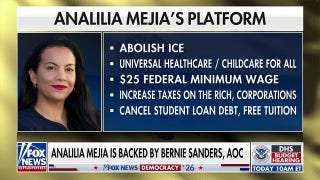
Democrat Analilia Mejia defeated Republican Joe Hathaway in New Jersey's 11th Congressional District special election, preserving the seat for Democrats and filling the final eight months of Gov. Mikie Sherrill's former House term. The result reinforces the GOP's challenge in a blue-leaning suburban district and has limited direct market relevance, though the race touched on SALT deduction policy, Gateway tunnel funding, and New Jersey military base cuts. Overall, this is a political update with minimal expected impact on financial markets.
The market relevance is not the special election itself, but the signaling value for the next eight months of House math. A Republican pickup would have marginally improved the odds of fiscal restraint; instead, this result keeps the chamber’s coalition fragile and raises the probability of more stopgap governance, especially around funding, debt-ceiling choreography, and any must-pass infrastructure/defense items. That tends to favor contractors and large-cap defense primes over narrower regional exposure because appropriations uncertainty usually pushes agencies toward incumbents with existing award vehicles rather than greenfield awards.
Second-order, the result weakens the probability of near-term policy volatility in New Jersey-linked infrastructure credits. If the congressional delegation remains aligned against cuts to Gateway-style projects and base funding, headline risk for rail and defense-adjacent names should compress over the next 1-2 quarters. The bigger implication is for SALT and affordability politics: if Republicans continue underperforming in suburban, high-income districts, leadership will have less room to trade away itemized-deduction relief in future budget negotiations, which is incrementally supportive for regional consumer demand in the Northeast and for issuers tied to local spending power.
The contrarian read is that this may be less a progressive surge than a low-turnout, anti-incumbent-special-election distortion. That matters because investors can overinterpret a one-off result as a durable shift in national preference, when the more actionable takeaway is that polarized turnout makes crossover appeal a poor base case. If the 2026 midterm environment normalizes and fiscal headlines worsen for Democrats, the current leftward signal could fade quickly.
Tail risks are mostly event-driven: a shutdown fight, a surprise bipartisan infrastructure deal, or a change in presidential messaging on SALT/border security could reverse the read within days. Over 6-12 months, the key catalyst is whether this result influences Democratic primary positioning in other suburban districts, which would matter more for policy mix than for the seat count itself.
AI-powered research, real-time alerts, and portfolio analytics for institutional investors.
Request DemoOverall Sentiment
neutral
Sentiment Score
0.00
