
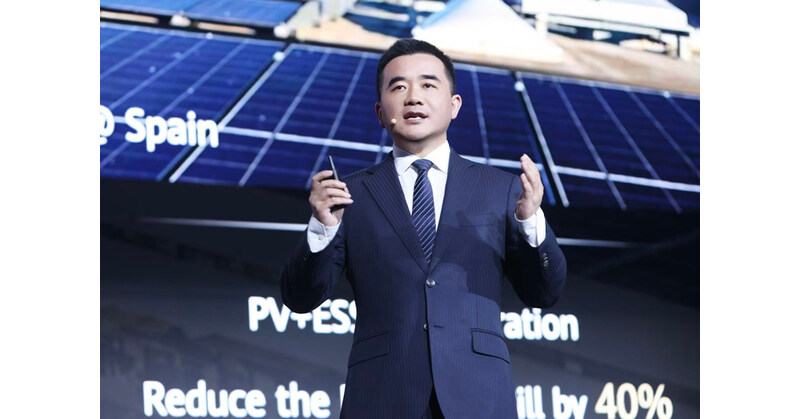
Huawei Digital Power said Europe is targeting ~64% wind/solar penetration by 2030 while grid resilience declines, prompting a shift to grid-forming BESS and new grid codes. The company highlighted validated grid-forming functions (black start, inertia support, short-circuit current support) and announced an upgrade of its LUNA energy storage brand to LUTERRA. Huawei also cited early project results—e.g., Germany C&I revenue +10% in two years and Spain reducing a Carrefour supermarket electricity bill by ~40% with a ~5-year payback—framing a move from energy arbitrage toward diversified grid ancillary services.
The investable shift here is not “more batteries,” it is a move from merchant arbitrage to regulated grid services. That favors vendors that can sell controls, power electronics, and software integration at the system level, while pure-play BESS models with thin hardware margins will see a slower monetization curve unless they can prove recurring ancillary-service revenue.
Second-order, the biggest winners are likely the infrastructure enablers: ABB, Schneider Electric, Eaton, and to a lesser extent Siemens Energy, because grid-forming adoption forces spending into substations, converters, controls, and commissioning rather than only cells. The losers are thermal peakers and any storage name whose value case still depends on spread capture alone; as ancillary markets deepen, their economics become more software- and dispatch-intensity-driven, which compresses the advantage of commodity battery capacity.
The contrarian point is that the headline narrative can overstate near-term revenue impact. European grid-code changes and procurement cycles are slow, and Huawei’s technology leadership does not translate cleanly into public-market share gain because security/procurement barriers can cap addressable market. If 1-3 month order flow does not re-rate, the structural thesis can still be right over 6-18 months, but the timing risk is high.
What would falsify the thesis is a delay in mandatory grid-forming requirements, or capex shifting toward transmission/synchronous condensers rather than BESS. That would keep the “story” positive but push the cash-flow benefit further out, which is negative for higher-multiple pure plays like FLNC and other storage integrators.
AI-powered research, real-time alerts, and portfolio analytics for institutional investors.
Request TrialOverall Sentiment
mildly positive
Sentiment Score
0.25
Ticker Sentiment
