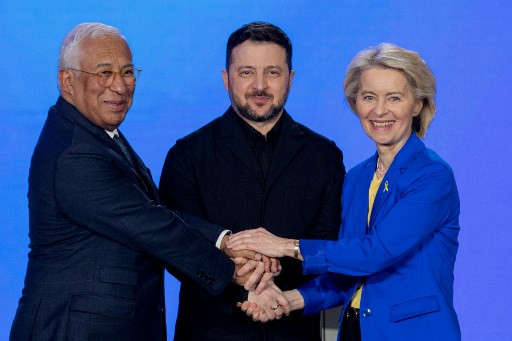
The EU said Ukraine will be fully integrated into Europe’s air defense, drone and counter-drone efforts, signaling deeper long-term defense cooperation. Von der Leyen also said the Ukraine Support Loan will provide €28.3 billion ($32.9 billion) this year to cover military needs. The announcement underscores continued EU backing for Kyiv and advances in Ukraine’s path toward EU membership.
The tradeable implication is not simply “more support for Ukraine,” but a gradual re-pricing of Europe’s defense stack toward persistent, budgeted demand for integrated air defense, UAVs, sensors, EW, and interceptor stockpiles. That favors firms with production capacity, NATO interoperability, and software-defined upgrade cycles over legacy platform-only names; the bottleneck is no longer concept but industrial throughput, which should keep pricing power intact for 12-24 months even if headline conflict intensity fluctuates.
Second-order beneficiaries are the European primes and specialty electronics suppliers sitting closest to the procurement queue, plus NATO-adjacent logistics and munitions supply chains. The less obvious loser is any European budget category that competes for fiscal space: every incremental defense appropriation makes it harder for peripheral sovereigns to fund social spending without higher issuance, which can widen long-end spreads in weaker euro members if growth rolls over. That dynamic also supports the case for higher-for-longer European defense spending multiple expansion, because the market may underestimate how much of this is now structurally embedded rather than crisis-driven.
The main catalyst risk is political: accession and funding processes can stall if coalition politics in key member states weaken, or if war fatigue intensifies after a temporary de-escalation. But the deeper risk to the consensus is the opposite of a quick peace dividend—if Ukraine’s battlefield know-how is fully absorbed into Europe’s defense architecture, the procurement cycle may extend for years and crowd out incumbents that cannot supply counter-drone systems at scale. The market is likely underestimating the secular demand uplift in low-cost interceptors and autonomous attritable systems versus expensive legacy air-defense platforms.
AI-powered research, real-time alerts, and portfolio analytics for institutional investors.
Request DemoOverall Sentiment
mildly positive
Sentiment Score
0.25
