
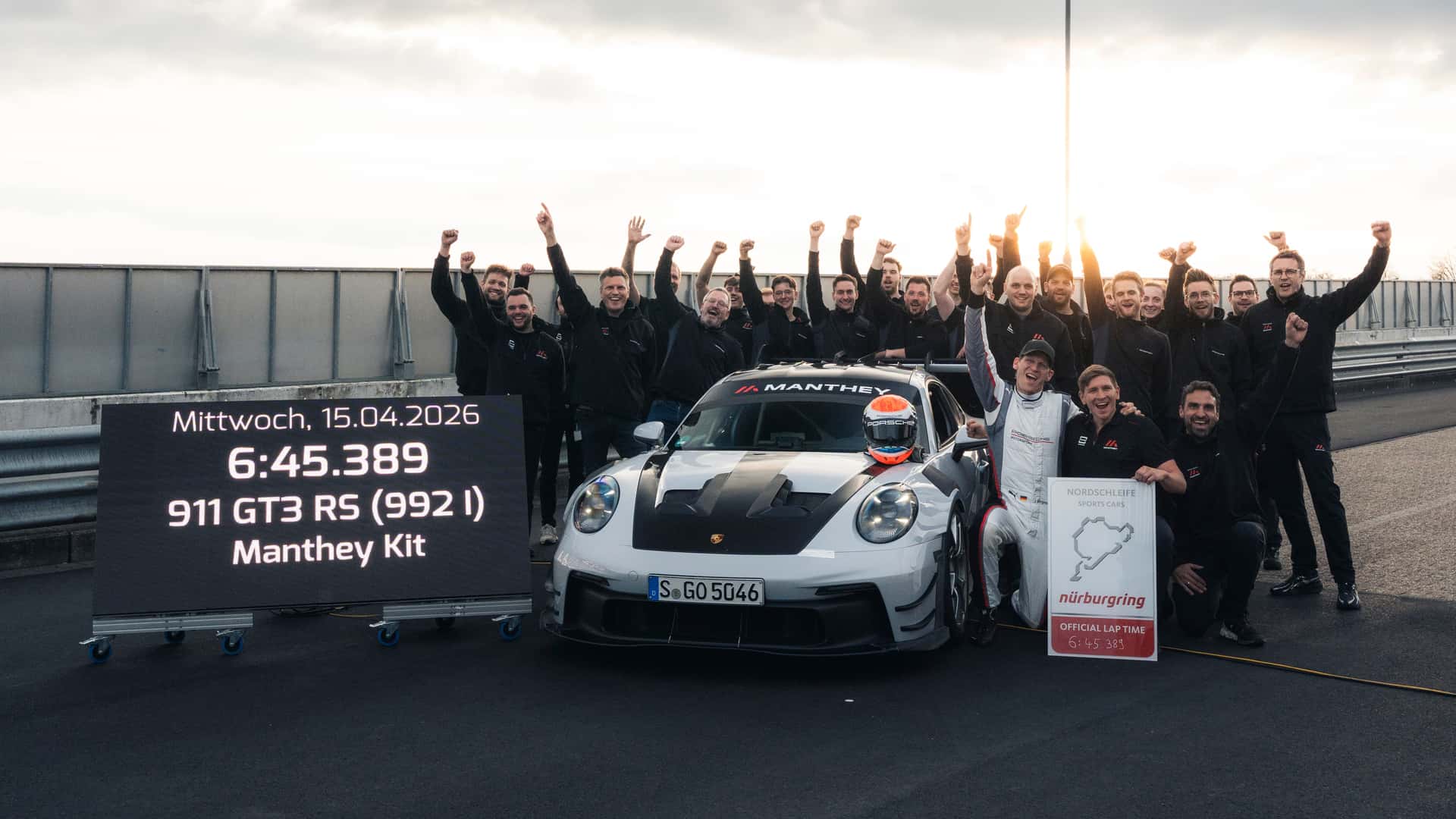
Porsche's 911 GT3 RS with the Manthey Kit posted a Nürburgring lap time of 6:45.389, improving on the standard GT3 RS's 6:49.328 but trailing the Ford Mustang GTD Competition's 6:40.835. The kit adds aerodynamic and suspension upgrades that generate 2,200 pounds of downforce at 177 mph, but it carries a steep $116,160 price on top of the $244,995 car. The article is primarily a performance showcase with limited direct market impact.
This is a signaling event for the halo-product war, not a volume event. The immediate economic winner is Porsche’s brand cachet and pricing power: a six-figure factory kit that meaningfully improves lap times reinforces the company’s ability to monetize performance credentials at high gross margins, while also validating a broader ecosystem of factory-backed upgrades. Second-order, it puts pressure on any competitor trying to claim “best-in-class” track performance because the benchmark is now a moving target that can be reset through optioned hardware rather than core vehicle redesign.
For Ford, the takeaway is less about one headline lap and more about the cost of maintaining narrative leadership. If the Mustang GTD becomes associated with one-off engineering heroics rather than repeatable product architecture, the market may eventually discount the halo effect as marketing spend instead of durable brand equity. That matters because the translatable benefit is not unit volume but uplift in aspirational traffic for adjacent trims; if the halo cools, the spillover to mainstream Mustang economics fades faster than investors expect.
The broader setup favors suppliers and track-performance adjacent components over OEMs. High-downforce aero, dampers, brake hardware, and tire technology become proof points that can support price increases across motorsport-derived product lines; the market may be underestimating how much this kind of public benchmarking accelerates aftermarket and factory accessory attach rates. The contrarian view is that these lap-time contests are near-term sentiment positives but weak fundamental signals: they do not materially change EV transition risk, mass-market demand, or fleet profitability, and the spending required to stay in the game can quietly compress margins over time.
AI-powered research, real-time alerts, and portfolio analytics for institutional investors.
Request TrialOverall Sentiment
mildly positive
Sentiment Score
0.22
Ticker Sentiment
