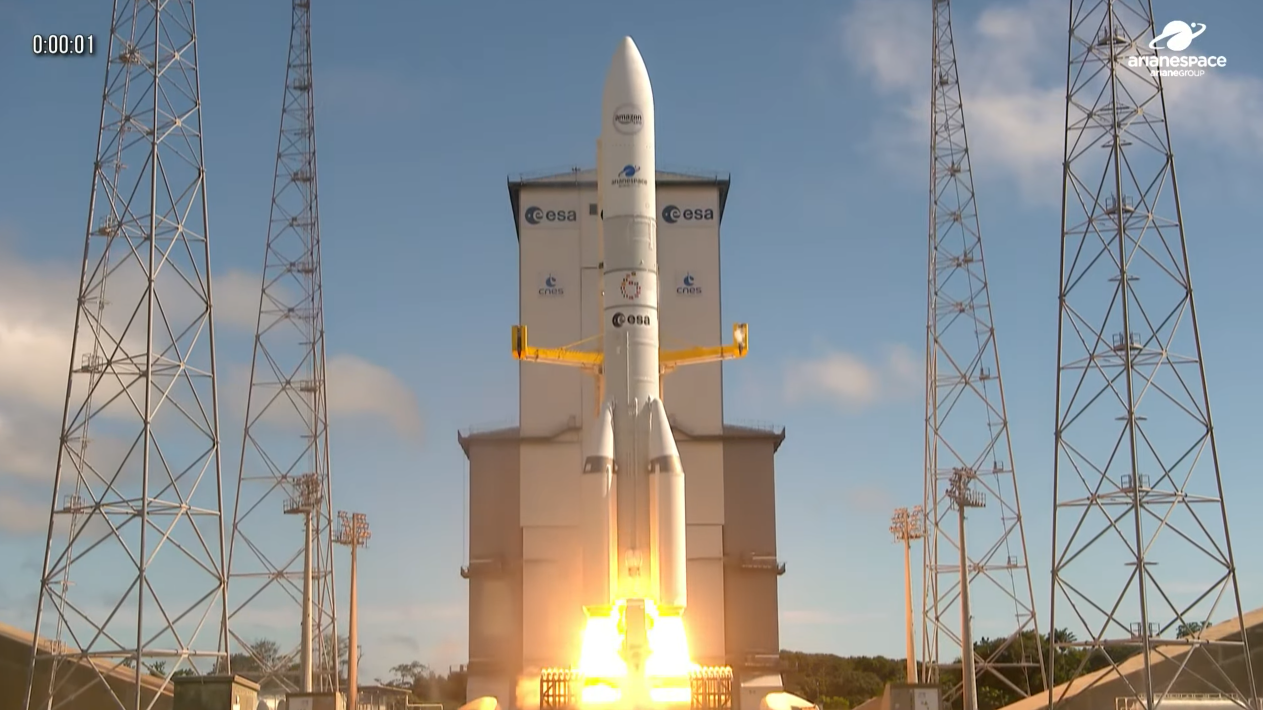
Ariane 6 completed its 8th overall flight, launching a record 36 Amazon Leo satellites and setting the heaviest payload ever lofted by an Ariane vehicle. The mission also debuted the more powerful P160C boosters, which Arianespace says will add more than two tons of LEO payload capacity and improve performance for future missions. The launch was successful and brings Amazon Leo to its 100th LEO satellite on the way to a planned constellation of more than 3,200 spacecraft.
This is less about a single launch and more about Amazon proving it can convert a capital-intensive constellation plan into repeatable industrial cadence. The market should care that larger batch sizes and a higher-performance booster reduce the implied launch cost per satellite and, more importantly, de-risk the timeline for service availability; constellation economics improve nonlinearly once launches get dense enough that deployment lag stops being the bottleneck. That shifts the narrative from "can they build it?" to "how fast can they monetize it?" — a meaningful inflection for AMZN because the optionality sits outside the core retail/cloud model and can be underappreciated in sum-of-the-parts work.
The second-order winner is likely the broader European launch ecosystem, but the valuation impact may be bigger for legacy telecom and rural broadband adjacency than for pure space names. Every step-function improvement in Amazon's deployment cadence increases competitive pressure on incumbent satellite and terrestrial low-density broadband providers, especially where fiber economics are weak and mobile backhaul remains expensive. The subtle read-through is that launch reliability is now becoming a gating input to connectivity competition; that favors scale players with vertically integrated launch-to-service pipelines and hurts smaller operators that need flawless execution but lack balance-sheet resilience.
The key risk is not the next launch, but customer adoption and unit economics over the next 12-24 months. If terminal-user economics are dragged by equipment costs, regulatory friction, or pricing pressure from Starlink, the market may keep assigning this business near-zero near-term value despite operational progress. Conversely, any evidence of subscriber traction or meaningful ARPU in enterprise/maritime/remote mobility would force a re-rating quickly because the street currently anchors on optionality rather than cash flow contribution.
The contrarian view is that investors may be too focused on the spectacle of launch cadence and underweighting competitive intensity. Scale matters here, and the incumbency advantage in LEO is still with the player already monetizing the network, so Amazon's progress is necessary but not sufficient. That argues for treating this as a process milestone, not a thesis change, unless the next 2-3 quarters show measurable commercialization rather than just more launches.
AI-powered research, real-time alerts, and portfolio analytics for institutional investors.
Request DemoOverall Sentiment
mildly positive
Sentiment Score
0.20
Ticker Sentiment
