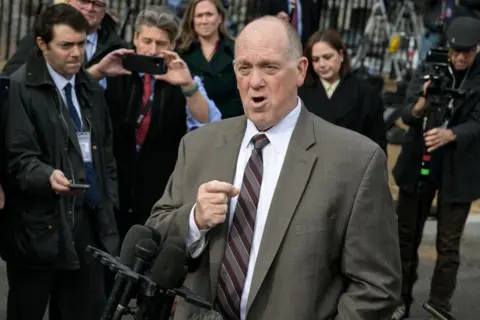
Federal immigration leadership in Minneapolis is shifting after the fatal shooting of Alex Pretti — the second Minneapolis resident killed by federal immigration officials since early January — as Border Patrol Commander Gregory Bovino is set to leave and Tom Homan will take over on-the-ground efforts. Roughly 3,000 immigration agents have been deployed to the city, tensions and protests have intensified, and the White House has signalled possible de-escalation including talks between President Trump, Governor Tim Walz and Mayor Jacob Frey and a potential reduction in federal agents. Authorities and elected officials are calling for a transparent, independent investigation into Pretti’s death, raising political and regulatory scrutiny rather than direct near-term market implications.
Market structure: This incident tightens political risk around federal immigration enforcement and creates asymmetric winners/losers — private prison operators (GEO, CXW) face downside if raids are scaled back, while defense/contract IT firms (LDOS, CACI, PLTR) that provide surveillance, analytics and oversight services likely see stable or rising demand. The observable scale (≈3,000 agents deployed) implies material near-term revenue for contractors but limited national budget elasticity; a 10–25% reduction in on-the-ground deployments would depress detainee-related revenue by a similar order for exposed operators over next 1–2 quarters.
Risk assessment: Tail risks include a congressional funding cut to DHS (low-probability, high-impact) or class-action suits forcing indemnity costs and contracts repricing; both could hit private-prison equity and insurers. Immediate (days): local volatility and reputational headlines; short-term (30–90 days): independent investigation outcomes and potential DOJ/DHS policy memos; long-term (6–24 months): budget reallocations and contract renewals shifting from detention to tech/monitoring solutions.
Trade implications: Favor rotating from pure detention exposure into security tech and systems integrators. Expect option IV to rise for GEO/CXW and PLTR around hearings or report releases; use 3–6 month puts on GEO/CXW and 3–9 month call spreads on LDOS/PLTR. Key catalysts: release of investigation within 30–90 days, congressional hearings, DHS agent-count guidance (watch for >=20% national pullback).
Contrarian angle: Consensus focuses on optics; market underprices the possibility that civil oversight will accelerate spending on monitoring/analytics rather than detention. Historical parallels (post-2014 oversight of ICE) show contract mix shifting toward tech within 6–18 months, creating a tactical 3–12 month alpha window for tech-heavy contractors versus operators of detention beds.
AI-powered research, real-time alerts, and portfolio analytics for institutional investors.
Request DemoOverall Sentiment
moderately negative
Sentiment Score
-0.40
