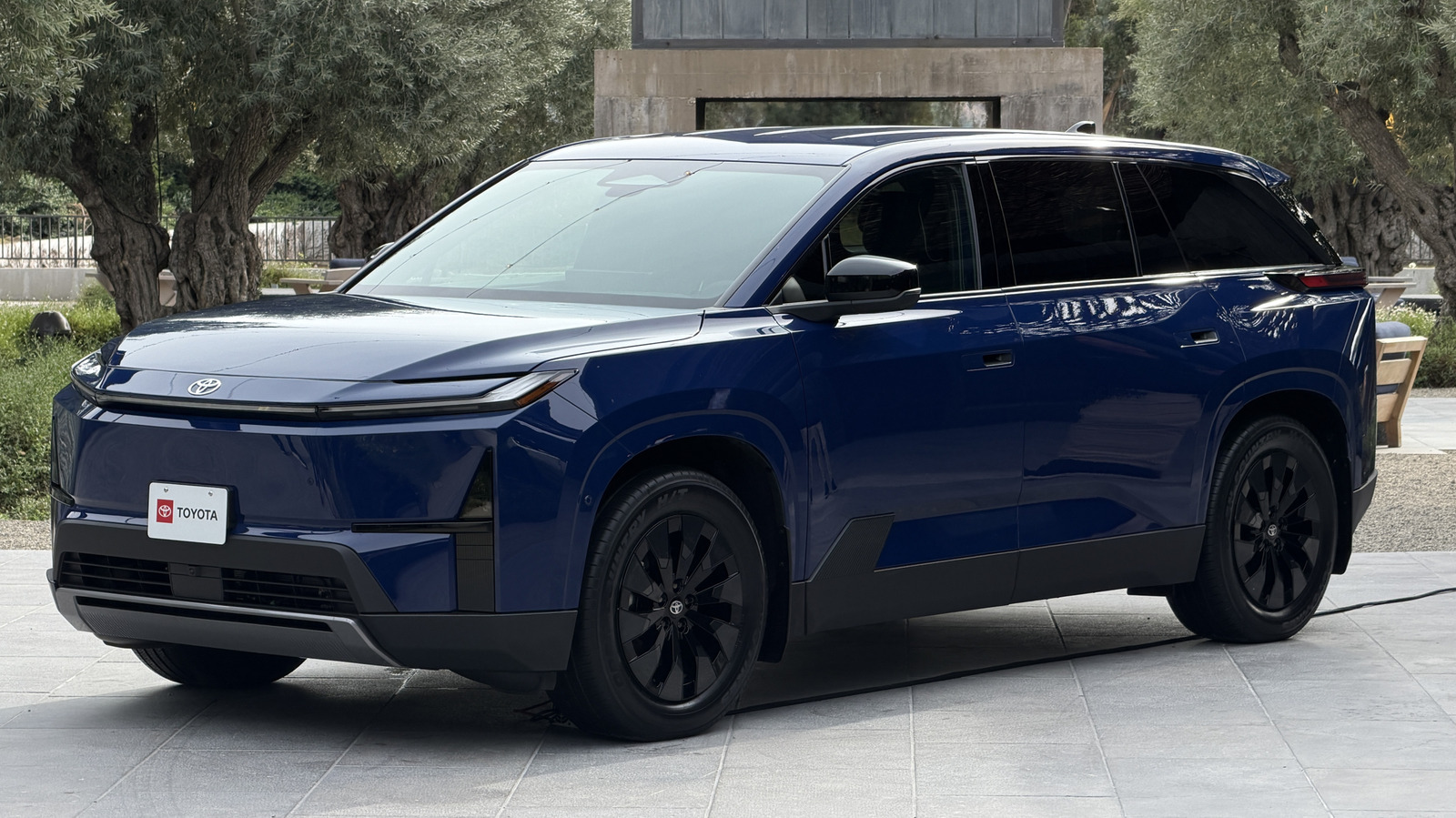
Toyota will offer the fifth-generation 2027 Highlander exclusively as an EV, launching late 2026 with a base XLE carrying a 77.0-kWh battery (RWD 221 hp/198 lb-ft, estimated 287-mile range) and AWD variants (338 hp/323 lb-ft, 270 miles) plus an optional 95.8-kWh pack delivering up to 320 miles. Key competitive datapoints: Hyundai Ioniq 9 uses a 110.3-kWh pack with EPA ranges of 335/320/311 miles depending on trim, while Kia EV9 starts with 76.1 kWh (230 miles) or 99.8 kWh (up to 305 miles); Kia/Hyundai support ~210–350 kW peak DC fast charging versus Toyota's likely ~150 kW. Estimated pricing positions the Highlander around $50k–$55k versus EV9 and Ioniq 9 starting at $56,545 and $60,555, respectively; Toyota’s shorter warranties (8yr/100k EV vs Koreans’ 10yr/100k and shorter basic coverage) and lower charging peak are tradeoffs that will influence buyer and investor preference despite strong pricing and Toyota brand strength.
Market structure: Toyota (TM) entering the three‑row EV segment at an estimated $50–55k materially undercuts the Kia EV9 ($56.5k) and Hyundai Ioniq 9 ($60.6k), implying Toyota can capture mainstream family-SUV share and force incumbents to defend via incentives or higher-spec trims. Superior U.S. production avoids tariff risk and supports margin resilience; winners include OEMs with scale and U.S. battery partners, losers are low‑volume premium EV startups and margin‑sensitive competitors. Risk assessment: Key tail risks are (1) consumer rejection of 400V/150kW charging versus 800V peers leading to weaker real‑world acceptance, (2) warranty/service cost surprises given Toyota’s shorter new‑vehicle warranty, and (3) supply shocks in U.S. battery capacity. Near-term (0–6 months) volatility will be driven by MSRP and EPA range reveals; medium/long term (6–36 months) by dealer take rates, used‑EV residuals and warranty claims. Trade implications: Tactical plays favor long TM exposure and charging‑roaming beneficiaries (NACS adopters) and short small EV makers with luxury positioning or weak balance sheets (LCID/RIVN). Use calendar‑aware option structures (9–18 month spreads) to express view while capping downside; also bias toward suppliers with U.S. cell capacity (LG/ SK partnerships) and away from China‑exposed smaller cathode/miners. Contrarian angles: Consensus underestimates Toyota’s brand pull in low‑price three‑row EVs — adoption could be faster than models anticipate, pressuring Hyundai/Kia margins by 200–400bp. Conversely, the market may underappreciate charging architecture as a demand differentiator: if charging speed perception persists, Toyota could lose share despite price, creating short windows around EPA/charging data releases.
AI-powered research, real-time alerts, and portfolio analytics for institutional investors.
Request DemoOverall Sentiment
mildly positive
Sentiment Score
0.25
Ticker Sentiment
