
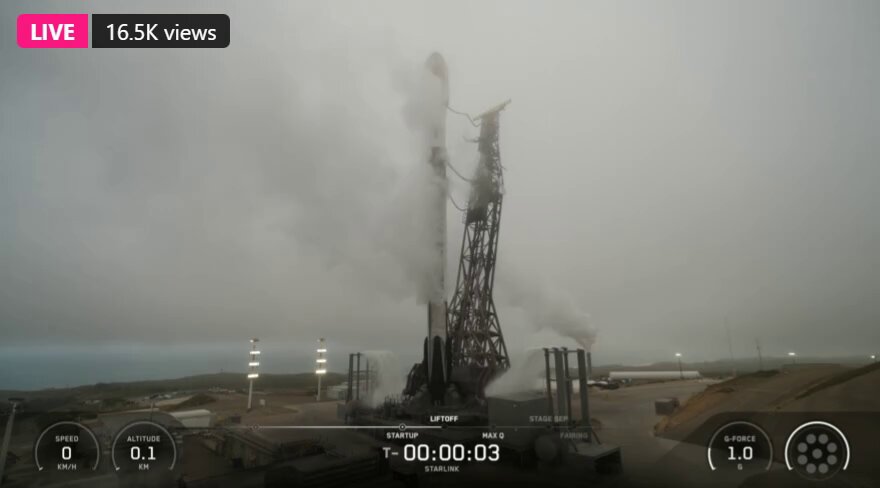
SpaceX successfully launched 24 Starlink satellites into low-Earth orbit and confirmed full deployment, while Falcon 9 booster B1082 completed its 22nd flight and landed safely on the droneship. The mission reinforces SpaceX’s rapid launch cadence and booster reusability, supporting continued expansion of the Starlink network. The article is largely factual, but it carries a mild positive read for SpaceX execution and broader connectivity coverage.
This is incrementally positive for TSLA, but not because of the launch itself — the important signal is that SpaceX’s delivery engine is still compounding at a pace that makes Starlink look increasingly like a utility rather than a speculative side project. That matters for Tesla because the market tends to underweight how much the broader Musk ecosystem can cross-subsidize network effects: better global coverage strengthens the practical value proposition for Tesla owners in low-density geographies, where connectivity anxiety is a real adoption friction.
The second-order winner is the reliability stack around SpaceX’s launch cadence. Repeated booster reuse lowers marginal launch costs and reduces schedule risk, which can pull forward Starlink cash flow durability and support a higher private-market valuation without requiring any change to Tesla fundamentals. Competitively, this pressures legacy satellite operators and rural broadband providers more than it moves the EV set; the more durable implication for TSLA is brand halo and ecosystem stickiness, not a near-term revenue inflection.
The market may be overpricing the immediacy of the benefit to Tesla. For TSLA, this is a months-to-years story, not a days-to-weeks catalyst: the direct financial linkage is limited, while the real option value is in an expanding connectivity layer that could make Tesla ownership more attractive in hard-to-serve regions. The contrarian risk is that investors extrapolate SpaceX momentum into TSLA multiple expansion too quickly, while auto margins remain driven by pricing, mix, and rate-sensitive demand.
Tail risk is execution drift: a launch cadence slowdown, booster failure, or regulatory friction would weaken the narrative fast and remove one of the cleaner examples of Musk-platform operating leverage. Near term, the best read-through is sentiment support and a modest uplift to long-duration TSLA holders, not a standalone earnings catalyst.
AI-powered research, real-time alerts, and portfolio analytics for institutional investors.
Request TrialOverall Sentiment
mildly positive
Sentiment Score
0.35
Ticker Sentiment
