


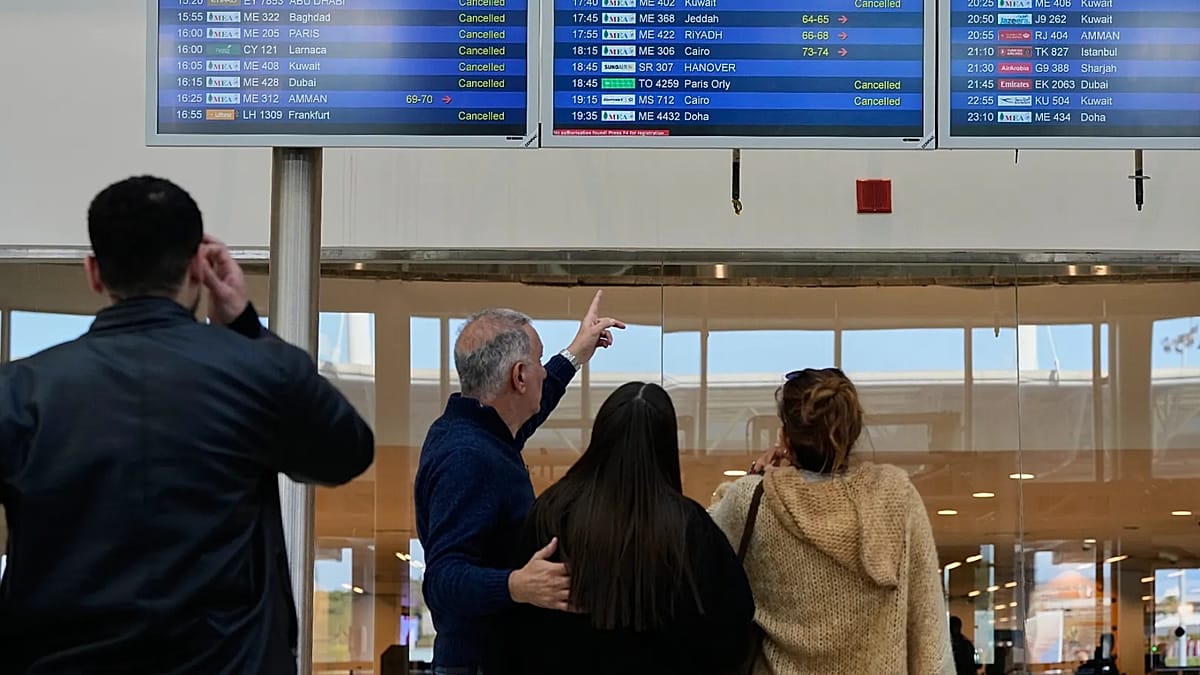
Escalation after US-Israeli strikes and Iranian retaliatory attacks has led to widespread Middle East airspace closures and suspension of operations at major hubs in Dubai, Abu Dhabi and Doha, with Flightradar24 reporting over 2,000 cancelled flights and tens of thousands of passengers affected as of 2 March. Major carriers (Emirates, Etihad, Qatar Airways, Oman Air, Saudia, Wizz Air, Turkish, KLM, Lufthansa Group, among others) have suspended or rerouted routes—disruptions that will add flying hours and fuel burn, raise near-term operational costs for airlines, pressure travel and logistics revenues around the region, and pose upside risk to jet fuel prices.
Market structure: Immediate winners are integrated energy majors (Brent-sensitive oil producers) and defense suppliers (e.g., LMT, NOC) as security risk premia lift commodity and defense spending expectations; direct losers are long-haul carriers with Gulf hub exposure (DAL, AAL, AC.TO) suffering route suspensions, higher fuel burn (+1–3% per diverted flight) and lost passengers (Cirium ~90k/day through Gulf hubs). Competitive dynamics favor non-Gulf carriers that can redeploy capacity quickly or those with strong domestic networks; pricing power for carriers is bifurcating — fares on alternative long-haul routings can rise 10–30% while unit costs spike.
Risk assessment: Tail risks include escalation that closes the Strait of Hormuz or Suez (Brent +15–40%, severe logistical shock) or prolonged insurance/exclusion zones raising operating costs by >5% for months. Time horizons: days—operational chaos and cancellations; weeks—revenue impact and reroute fuel costs hit Q1 guidance; quarters—persistent demand shifts if hubs restructured. Hidden dependencies: crew duty limits, AOG spare positioning, reinsurer capacity and war-risk premiums; catalysts to reverse include rapid de-escalation, diplomatic corridor reopenings or insurer reopening statements.
Trade implications: Direct plays: short airline operating exposure (DAL, AAL, AC.TO) vs long energy/defense. Options strategies: buy 30–60 day 5–7% OTM puts on DAL/AAL sized 1–3% NAV to capture near-term vol; finance with 3-month Brent call spread (e.g., $85/$100) to express oil risk. Pair trade: long XOM (2% NAV) vs short DAL (2% NAV) to hedge macro energy upside; rotate 2–4% from Travel & Leisure into Energy and Defense over next 7–21 days.
Contrarian angles: Consensus focuses on short-term airline pain but underestimates accelerated structural rerouting that could benefit non-Gulf transatlantic carriers and cargo operators — ticket scarcity could lift yields 8–15% if disruption <3 weeks. If conflict is contained within 10–14 days, current airline sell-off may be overdone: prepare to cover shorts and consider selective 3–6 month calls on well-capitalized carriers with low Gulf exposure once capacity visibility returns and IV collapses.
AI-powered research, real-time alerts, and portfolio analytics for institutional investors.
Request TrialOverall Sentiment
moderately negative
Sentiment Score
-0.60
Ticker Sentiment
