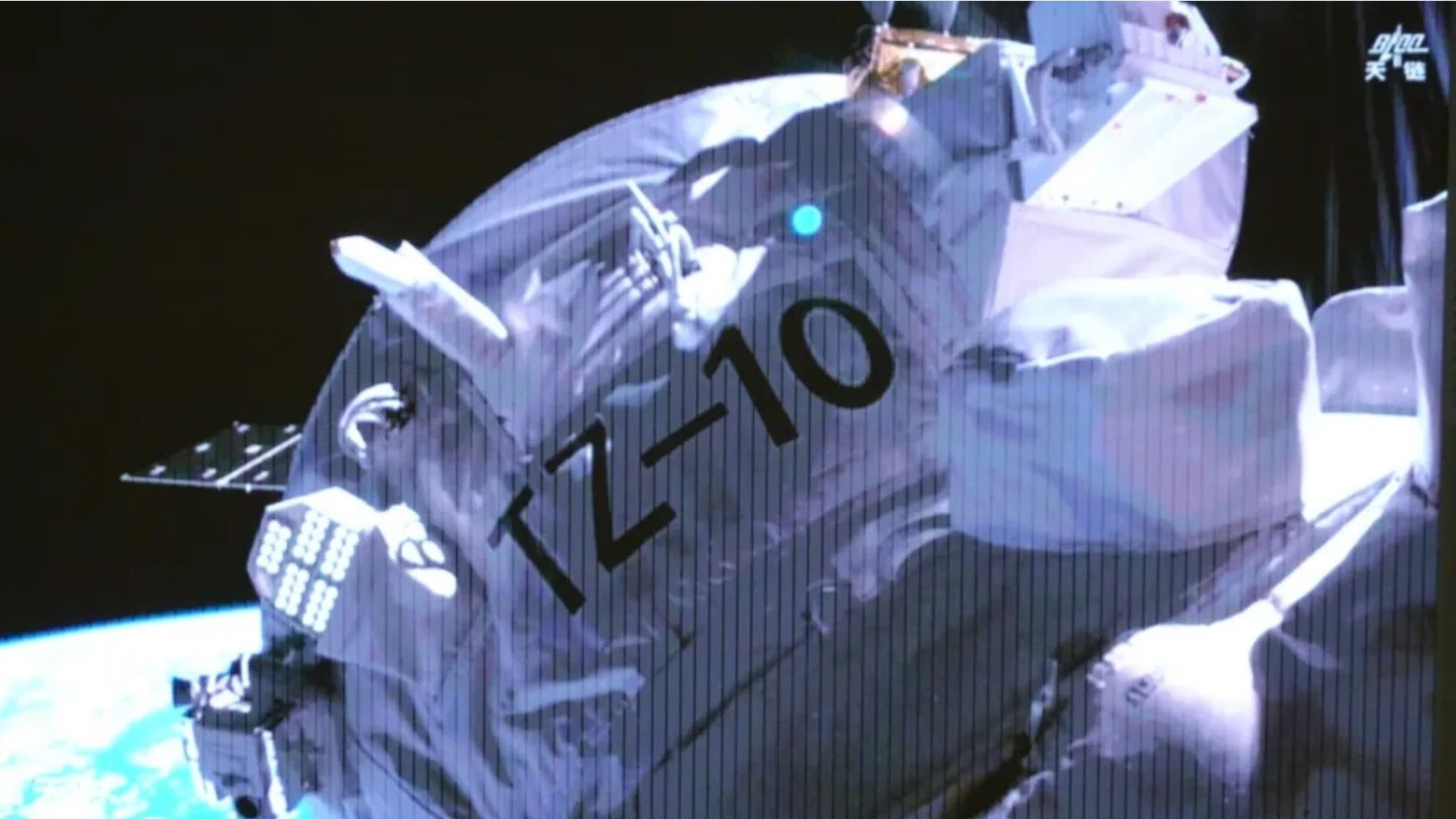
China's Tianzhou 10 cargo ship delivered nearly 7 tons of supplies to the Tiangong space station, including about 280 kg of scientific experiments, 700 kg of propellant, and the last of three new spacewalking spacesuits. The freighter docked about five hours after launching on a Long March 7 rocket from Wenchang on May 10/11. The article is primarily a factual mission update with limited direct market implications.
This is a small but useful read-through on China’s ability to sustain a closed-loop space logistics stack. The important second-order effect is not the cargo itself, but the cadence: regular freighter rotations imply Tiangong is no longer a prestige project so much as an operational platform with recurring replenishment demand, which supports domestic launch utilization and improves reliability learning curves across the Long March family.
For the supply chain, the marginal beneficiary is the ecosystem around propulsion, life-support consumables, docking systems, and space-grade materials rather than any single launch headline. The delivery of propellant and EVA hardware suggests the station is shifting from assembly to utilization, which tends to increase consumption of higher-value, lower-volume subsystems over the next 6–18 months. That matters because operational stations create a steadier procurement profile than one-off exploration missions, which is usually better for Chinese aerospace vendors with state-backed backlog visibility.
The contrarian angle is that this is strategically meaningful but financially non-translatable in the near term for listed global equities. Public-market exposure to China’s civil space stack is limited, and any attempt to monetize the theme through broad China industrial names risks dilution from weak macro and policy opacity. The more investable implication is indirect: sustained Chinese orbital operations reinforce the defense/space competition narrative, keeping Western sovereign budgets biased toward launch resilience, ISR, and dual-use space infrastructure.
Near-term risk is execution, not demand. A launch failure or docking anomaly would be a fast negative for sentiment, but the larger catalyst window is 12–24 months, when repeated mission success can justify higher domestic procurement and more ambitious station utilization. If that happens, the trade is less about China space equities and more about Western prime contractors and launch infrastructure names with exposure to hardened supply chains and government refresh cycles.
AI-powered research, real-time alerts, and portfolio analytics for institutional investors.
Request DemoOverall Sentiment
neutral
Sentiment Score
0.05
