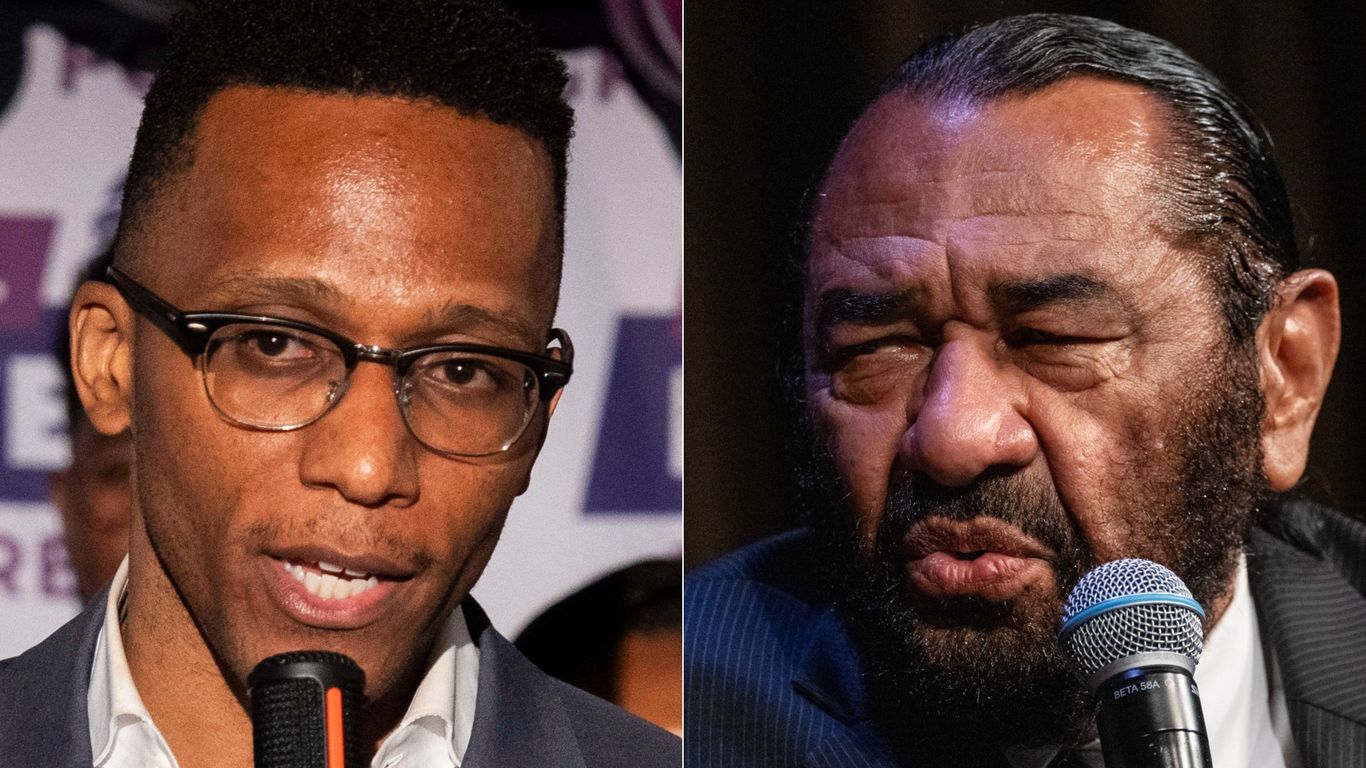
Christian Menefee defeated incumbent U.S. Rep. Al Green in the Democratic runoff for Houston's newly redrawn 18th Congressional District, taking 68.6% of the vote (21,678) to Green's 31.4% (9,930) with 61% counted. Menefee, who already won a special election earlier this year, will now face Republican Ronald Whitfield in November. The result ends Green's two-decade run in Congress and reflects the impact of Texas redistricting on the district's political balance.
The immediate market read-through is not about a single House seat; it is about confirmation that the new district lines are already doing the work they were designed to do. That lowers the probability of a meaningful legal or political rollback in the near term and makes the district effectively lower-beta for Democratic control than the legacy seat was, even if the broader Texas map remains hostile. For investors, that matters mainly through the state-policy channel: Texas-specific regulatory, healthcare, energy, and municipal-credit narratives are less likely to see abrupt federal representation shifts than the headline suggests.
The bigger second-order effect is on intra-party power: a younger, more transactional Democrat winning decisively over a long-tenured incumbent signals that fundraising networks and local machine support are now more important than seniority in safe urban seats. That tends to accelerate a “careerist” style of governance where officeholders optimize for district-level deliverables and donor architecture rather than national ideological positioning. The crypto-super-PAC angle is a reminder that alternative financing can still buy influence at the margin, but it also raises ethical-friction risk that can surface later in committee assignments, local procurement, or primary challenges.
The contrarian point: the market may be underestimating how quickly the seat could become irrelevant for policy if national control stays split. In that case, the real catalyst is not November but the next redistricting/legal cycle over the following 12-24 months, which could either lock in the current map or create another forced migration of incumbents. Tail risk is a surprise GOP overperformance in the general election, but with a nominee profile that looks weak, the base case is that this race is more about sequencing than directionality.
AI-powered research, real-time alerts, and portfolio analytics for institutional investors.
Request DemoOverall Sentiment
neutral
Sentiment Score
0.05
