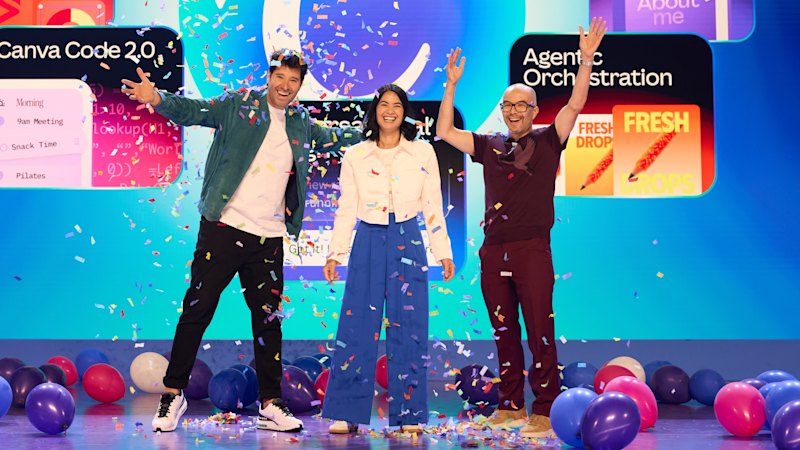
Canva unveiled Canva AI 2.0, a major AI-first rebuild that adds conversational design, agentic orchestration, connectors to Slack/Gmail/Calendar, and a proprietary Design Model. Management said the rollout will start with 1 million test users and is intended to support a future shift from feature-based pricing to AI credits ahead of an expected 2027 IPO. The launch is strategically important as Canva tries to defend its $100 billion valuation amid SaaS sector pressure and rising AI competition.
Canva is trying to convert a feature-led product into a workflow OS before AI-native point solutions permanently unwind its bundle economics. That is the right strategic response, but it also means the company is implicitly admitting that usage is migrating from the UI layer to the task layer — a much harder moat to defend because it depends on retention at the operator level, not just team-level seat counts. The second-order risk is that the more successful Canva becomes at orchestration, the more it trains users to treat the platform as a routing layer for best-in-class AI tools, which could compress pricing power even if gross usage rises.
The near-term catalyst is not revenue; it is whether the first 1M users produce enough signal on willingness to pay for credits versus feature access. That matters because AI monetization introduces a variable-cost stack that can turn what used to be a pure software multiple into something closer to a usage platform, with margin compression risk if adoption spikes faster than pricing. The market is likely underestimating how quickly compute economics can pressure FCF optics long before GAAP catches up, especially if Canva uses aggressive credit pricing to defend growth into an IPO window.
Competitive spillovers are broader than the obvious names. If Canva proves editable, multi-step agentic design works at scale, it raises the bar for Adobe, Figma, and adjacent workflow players that have been selling point solutions into fragmented intent. But if users still drift to specialized tools for sub-tasks, this launch accelerates category decomposition: the winner may be the AI layer that sits above design, not the design platform itself. The contrarian view is that the market may be over-discounting Canva’s bundle because incumbents with distribution, brand memory, and enterprise connectors often re-bundle successfully once they re-architect around workflow ownership.
AI-powered research, real-time alerts, and portfolio analytics for institutional investors.
Request DemoOverall Sentiment
mildly positive
Sentiment Score
0.20
Ticker Sentiment
