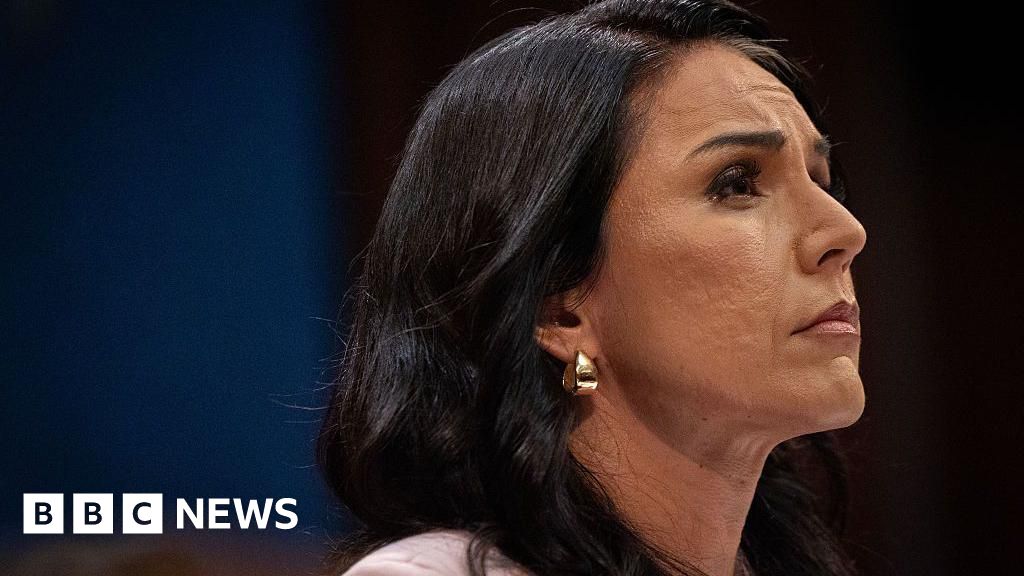
Tulsi Gabbard will resign as US director of national intelligence effective 30 June, citing her husband's bone cancer diagnosis. Aaron Lukas, the principal deputy director, will serve as acting director. The move is a personnel change within the Trump administration and is unlikely to have a direct market impact.
This is less a policy shock than a governance continuity event, but the market-relevant angle is that intelligence leadership churn now adds to an already elevated turnover rate inside the national security apparatus. That matters because intelligence coordination quality is a quiet input into everything from sanction enforcement to escalation calibration; when it degrades, the first-order market effect is usually not price action but wider dispersion in geopolitically sensitive assets and a higher volatility floor in defense, cyber, and commodities.
The key second-order effect is that an acting director tends to be less able to force inter-agency alignment on fast-moving crises. Over the next 1-3 months, that increases the odds of slower or noisier policy execution on Iran, Cuba, and Venezuela, which could either delay escalatory steps or create a gap between rhetoric and implementation. For investors, that argues against assuming a clean continuation of the current foreign-policy trajectory until a permanent replacement is confirmed and the new chain of command is proven.
The contrarian take is that personnel volatility can actually reduce tail risk in the very near term if it slows decision-making at the margins. In other words, the biggest upside in risk assets may come from a temporary lower probability of abrupt, intelligence-driven action rather than from any improvement in fundamentals. The market is likely to underappreciate this distinction because it treats cabinet changes as binary political noise instead of as a degradation in execution capacity.
From a trading perspective, this is a modest volatility setup rather than a directional macro thesis: the base case is a short-lived repricing in geopolitical premium, with the highest sensitivity in defense primes, cyber, and energy hedges if the vacancy persists into a period of heightened external tension. The main catalyst is the appointment process for a permanent successor; if that drags past a few weeks, expect investors to price a more fragmented policy process and wider event risk around sanction and military decisions.
AI-powered research, real-time alerts, and portfolio analytics for institutional investors.
Request DemoOverall Sentiment
neutral
Sentiment Score
0.00
