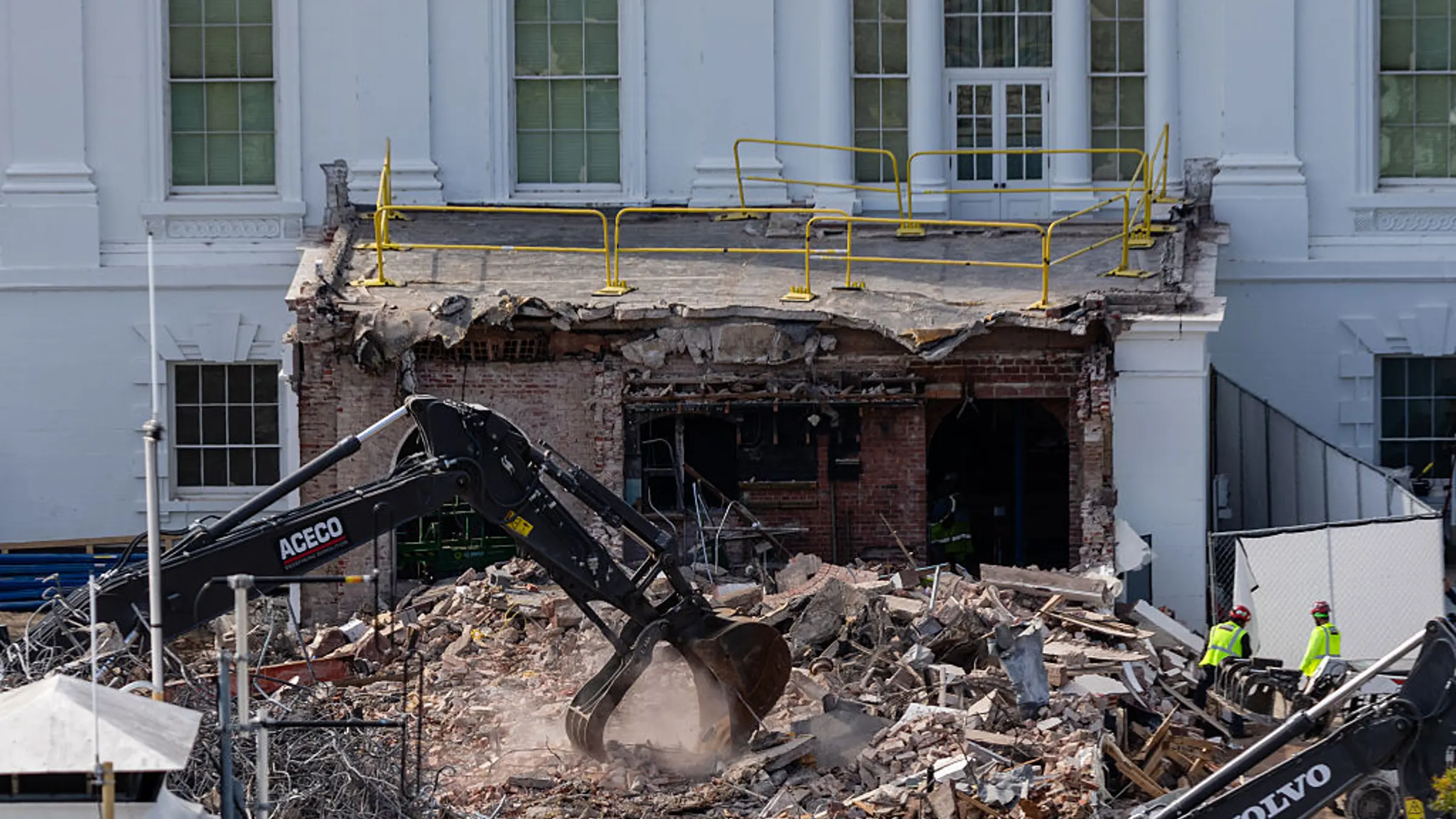
Trump said the White House ballroom project cost has risen from about $200 million to 'something less than 400,' though he argued the larger project remains 'ahead of schedule, and under budget.' Senate Republicans are considering $1 billion for White House security upgrades and a separate GOP proposal would provide $400 million for the ballroom, offset by customs fees. The project has also faced a preservation-group legal challenge and a court order limiting construction absent congressional authorization.
This is less a real estate story than a funding and governance signal: the project is being repositioned as “security infrastructure,” which materially broadens the political coalition that can defend it. That framing matters because it creates a path for quasi-public financing through appropriations, customs offsets, or agency-related security spend, reducing the probability that the cost burden stays purely discretionary. The market implication is that headline risk likely persists, but execution risk is now shifting from “can it be built?” to “who pays and how is it categorized,” a much more durable battlefield over the next 1-3 quarters.
The second-order effect is on the federal security/contracting complex. If lawmakers bless perimeter/security upgrades tied to the project, the spillover beneficiaries are not construction names alone but firms with cleared labor, secure-facilities expertise, and federal interior/security budgets. That favors defense systems integrators and niche federal contractors over pure-play commercial builders, because the value accrues in classified systems, secure comms, access control, and underground hardening rather than visible construction volume.
The legal overhang is real but asymmetric. Courts can slow visible work, yet once the project is wrapped in security rationale, injunctions become harder to sustain on urgency grounds, which increases the odds of incremental progress even amid litigation. The contrarian miss is that controversy can actually improve financing optionality: the more politically fraught the project becomes, the more incentive there is to route costs through less visible government line items rather than abandon it. That reduces tail downside for contractors with incumbent federal relationships, while keeping reputational risk elevated for consumer-facing architects, landscapers, and materials names tied to the project by association.
AI-powered research, real-time alerts, and portfolio analytics for institutional investors.
Request DemoOverall Sentiment
mildly negative
Sentiment Score
-0.10
