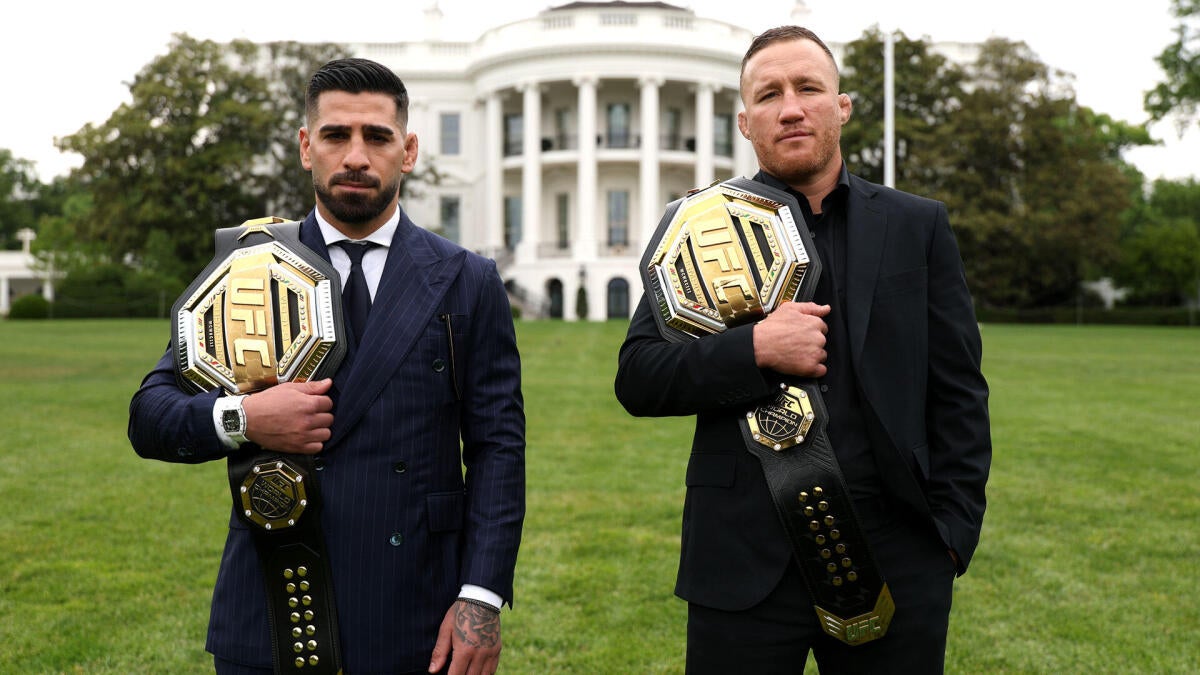
UFC Freedom 250 is scheduled for Sunday, June 14 at the White House in Washington, D.C., with a seven-fight card headlined by Ilia Topuria vs. Justin Gaethje for the undisputed lightweight title and Ciryl Gane vs. Alex Pereira for the interim heavyweight title. The event will stream live on Paramount+ with plans starting at $8.99/month or $89.99/year. The article is primarily an event preview and odds listing, with limited direct market relevance beyond entertainment and subscription demand.
This is less a sports headline than a one-day demand shock wrapped in a brand event. The relevant second-order effect is not UFC ticketing economics but incremental subscriber acquisition and churn reduction for the streaming distributor: a marquee, exclusive live window with appointment viewing can lift trial starts, reduce weekend churn, and modestly improve retention into the next billing cycle. The White House venue adds earned media value that usually takes paid marketing spend to replicate, so the marginal ROI is likely highest for the platform and the promotion’s broader media rights ecosystem rather than the fight card itself.
The more interesting angle is behavioral: combat sports with unusually high star power and “must-watch-live” framing tend to pull forward viewing rather than expand total category hours. That means the winner is often the platform with the strongest bundling and conversion funnel, while nearby competitors in streaming and sports media can see localized attention loss for 24-72 hours without any durable share shift. On the consumer side, this kind of event supports premium willingness-to-pay for live sports, which is constructive for ad-light subscription tiers and for any media company with scarce live inventory.
The main risk is that one-off spectacle can be misread as sustainable engagement. If post-event retention data disappoints, the market can quickly re-rate the event as an expensive marketing stunt rather than an acquisition engine, especially if churn cohorts normalize over the following 1-2 billing cycles. The contrarian view is that the venue itself may be more valuable than the card: the political/PR halo could create a temporary spike in search interest and social impressions that overstates actual monetizable demand, making any near-term enthusiasm vulnerable to fade.
From a trading lens, this is best expressed as a short-duration engagement trade, not a long-duration fundamental call. Any positive read-through should be treated as a data point for live-sports monetization and retention, with the burden of proof on whether the uplift persists beyond the event window.
AI-powered research, real-time alerts, and portfolio analytics for institutional investors.
Request DemoOverall Sentiment
neutral
Sentiment Score
0.10
