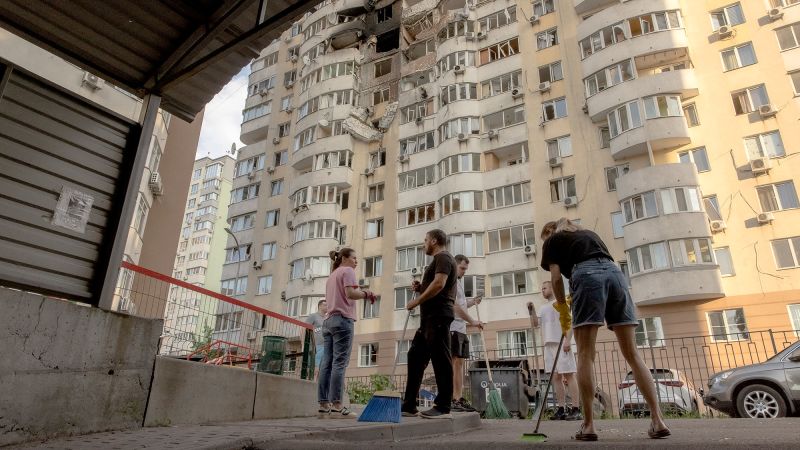
Russia has significantly increased its drone and missile attacks on Ukraine in recent weeks, launching hundreds in single nights and overwhelming Ukrainian air defenses. Moscow has scaled up domestic production of Iranian-designed Shahed drones, now producing an estimated 2,700 per month, and is employing decoy drones to further strain Ukrainian resources. While Ukraine is intercepting a high percentage of drones, the increased volume and evolving tactics, including higher altitudes, are posing challenges, requiring the use of more limited missile supplies and prompting a shift to drone-to-drone interceptors, with President Zelensky noting that Ukrainian production lags significantly behind Russia due to financial constraints.
Russia has markedly escalated its aerial warfare against Ukraine, deploying a significantly increased volume of drones and missiles, with up to 479 launched in a single night and seven of the largest drone attacks occurring in the past four weeks. This surge is supported by Russia's enhanced domestic production capabilities, estimated at approximately 2,700 Iranian-designed Shahed drones and 2,500 decoy drones per month, enabling nightly barrages of 300 to 400 units. These attacks incorporate new tactics, such as flying drones at higher altitudes (2-5 kilometers), rendering machine gun defenses less effective and forcing Ukraine to expend more valuable missile resources. Consequently, while Ukrainian air defenses still intercept around 80% of incoming drones, this represents a decline from a previous ~95% efficiency rate, highlighting the strain on resources. Ukrainian President Zelensky noted a significant drone production disparity, with Ukraine producing about 100 drones daily compared to Russia's 300-350, citing financial constraints as the primary limiting factor for Ukraine. Despite the intensified air campaign, which has resulted in at least 154 civilian deaths and 900 injuries in the last four weeks, the ground war front line has remained largely static since November 2023, suggesting the air attacks aim to degrade Ukrainian morale and defense capabilities rather than achieve immediate major territorial advances. Ukraine is adapting by exploring drone-to-drone interceptor technology, but its overall access to air defense systems remains constrained by Western allies' supply capacities.
AI-powered research, real-time alerts, and portfolio analytics for institutional investors.
Request DemoOverall Sentiment
strongly negative
Sentiment Score
-0.75
