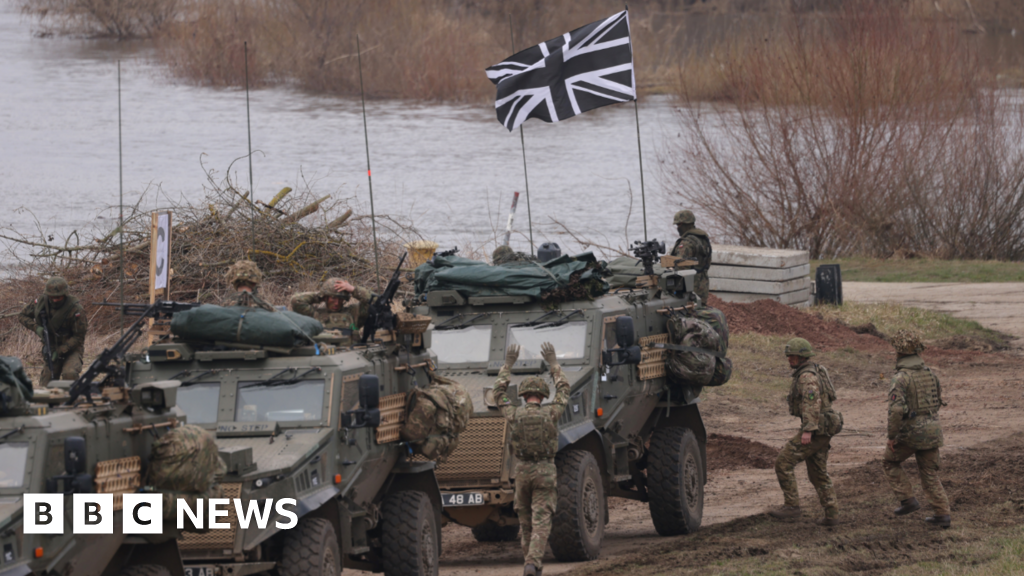
Prime Minister Sir Keir Starmer pledged that MPs would have a say on any deployment of British troops to police a peace agreement in Ukraine, aligning with recent parliamentary practice, while not specifying troop numbers. The UK and France signed a declaration of intent to deploy forces by air, land and sea and said Ukraine would authorize allies to use “necessary means,” a move intended to deter further Russian attacks but one Moscow warns would make foreign personnel legitimate targets; the proposal raises sovereign-risk and defense-policy implications for markets if it proceeds to long-term deployments.
Market structure: Immediate winners are defense primes, logistics and munitions suppliers (US: LMT, RTX, NOC; UK: BA.L, BAB.L) and commodity producers (oil, gas, base metals) as demand for sustainment and stockpiles rises; losers are European travel/leisure (IAG, RYA.L), insurers with geopolitical exposure, and Russian assets. Concentration of orders to a small group of primes increases pricing power and backlog visibility—expect orderbook growth of +10–25% for select suppliers over 12–24 months versus broader industrials.
Risk assessment: Tail risks include direct NATO engagement, strikes on allied troops, or major sanctions provoking oil >$100/bbl and EU gas shocks; probability low but impact severe. Near-term (days) look for FX and equity volatility spikes; weeks–months hinge on parliamentary votes and US guarantees; quarters+ see durable defense budget uplift (continental NATO members targeting +2–5% real CAGR in defense spend over 3–5 years). Hidden dependencies: UK parliamentary rejection would materially weaken GBP and UK-listed defense names despite headline coordination.
Trade implications: Direct plays—buy defense sector ETF XAR and selective large-cap primes (LMT, RTX, NOC) with 6–12 month horizon; short airline/consumer discretionary exposure (IAG, RYA.L, JETS). Use options: buy 6–12m call spreads on LMT/RTX or 3–6m puts on European travel ETFs to asymmetrically capture volatility. Rotate capital from consumer cyclicals into defense, energy and gold over next 2–8 weeks, trimming at 20–30% realized gains.
Contrarian angles: The market may overprice an immediate large troop deployment; initial defense stock pops can be faded into, favoring suppliers with contracted sustainment revenue (BAB.L, RR.L) rather than primes at rich multiples. Historical parallels (2014–2016) show re-rating takes 6–18 months as budgets are legislated—position for a multi-stage, not instantaneous, rerating and beware headline-driven volatility spikes.
AI-powered research, real-time alerts, and portfolio analytics for institutional investors.
Request DemoOverall Sentiment
moderately negative
Sentiment Score
-0.30
