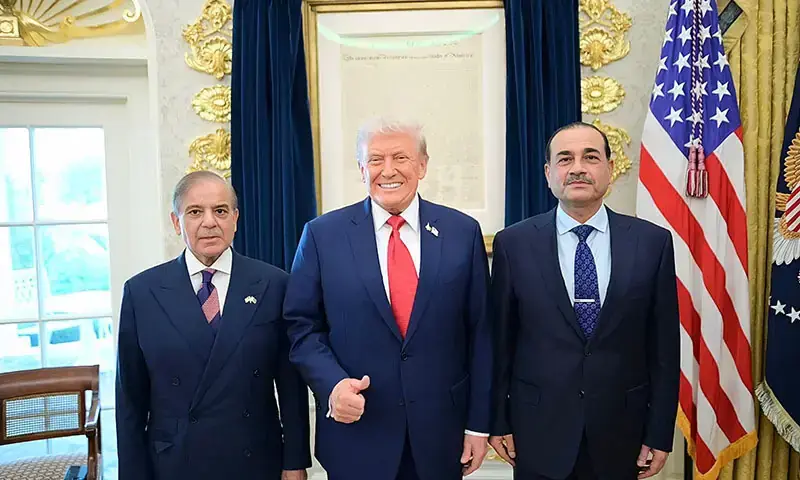
Pakistan said President Trump’s peace efforts are advancing a delicate US-Iran mediation process, with PM Shehbaz Sharif calling a recent multi-country call “very useful and productive” and Foreign Minister Ishaq Dar describing it as a step toward regional stability. The latest round of diplomacy centers on an interim framework covering the Strait of Hormuz, Iran’s nuclear program, sanctions relief and guarantees against renewed military action. While the tone is constructive, the situation remains highly contingent and geopolitically sensitive.
The market implication is not a direct asset price move but a change in tail-risk distribution across the Gulf logistics stack. Even a partial de-escalation around Hormuz reduces the probability of a short-lived but violent dislocation in tanker rates, LNG shipping, insurance premia, and refined-product arbitrage; that matters more for second-order beneficiaries than for headline oil beta. The cleaner trade is not “lower oil” but “lower volatility,” which tends to compress implied vol in energy, shipping, and EM FX while supporting risk appetite in Pakistan-linked and Gulf-sensitive assets.
Pakistan is the underappreciated option on diplomatic credibility: if it can repeatedly bridge Washington and Tehran, it gains soft-power leverage that may translate into incremental bilateral support, IMF goodwill, and less punitive treatment in future financing discussions. The flip side is domestic overhang — any perception that military leadership is centralizing foreign policy could create political friction if the process stalls or if concessions are seen as one-sided. For markets, the relevant second-order effect is that a stable mediation role could modestly improve Pakistan’s external funding spread over the next 1-3 months, but only if talks continue to produce visible milestones.
The main contrarian risk is that the current optimism is priced off process, not settlement. If the framework slips, the move back to strikes/sanctions could be abrupt and binary within days, reintroducing a jump in crude, freight, and insurance before fundamentals have time to adjust. Conversely, if a narrow interim deal emerges, the upside for risk assets may be modest because much of the relief is already captured in expectations; the more durable trade would then be in vol compression rather than outright directional exposure.
AI-powered research, real-time alerts, and portfolio analytics for institutional investors.
Request DemoOverall Sentiment
mildly positive
Sentiment Score
0.15
