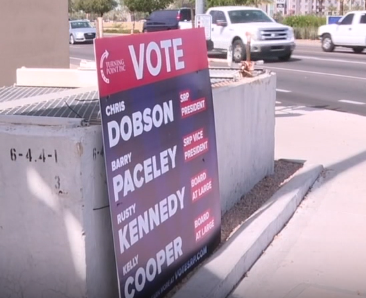
22,000 early ballots were cast five days before the SRP election—roughly three times prior turnout (~7,500)—in a high-profile vote over control of the Salt River Project, a major public utility that sets regional electricity rates. National groups (Turning Point Action, Jane Fonda Climate PAC) and local landowners are mobilized amid rising electric bills driven in part by demand from new data centers and semiconductor fabs; SRP says it plans to double capacity over the next decade (~+100%). The election outcome will determine governance and rate-setting for a large public utility, creating primarily local/regulatory risk rather than a broad market shock.
This election is a governance-led regulatory shock with investment-pathway consequences: the winner will determine who bears multi-billion-dollar distribution and generation capex over the next 5–10 years, and that allocation—not the headline politics—will drive cash flows for developers, EPC contractors and large industrial power users. If the result tilts toward rate-constraining oversight, expect capex deferrals and a higher probability of ad hoc cost-shifting (surcharges, special assessments) that compresses private-sector contract margins for builders but shields large on-site consumers in the near term.
Second-order winners are firms that monetize scarcity and ancillary services: battery-storage providers, frequency response aggregators and short-lead-time gas peakers that can be contracted under IRRs that rise with utility risk premia. Conversely, data center REITs and hyperscalers with thin marginal-power economics will see OPEX sensitivity re-priced into valuations if utility cost pass-through weakens; a 10–20% sustained uplift in regional retail power rates typically reduces EBITDA margins for heavy consumers by 5–12% depending on hedging.
Catalysts and timing: the election is the immediate binary (days), but the material impacts will manifest over 6–24 months via rate cases, procurement timelines and equipment lead times (transformers/turbines 12–30 months). Tail risks include prolonged litigation or federal intervention that freezes pricing mechanisms for multiple years; the reversals are equally clear—transparent long-term PPAs or a regulatory-approved cost-recovery mechanism would rapidly re-rate developers and EPC backlogs positively within 3–6 months of approval.
AI-powered research, real-time alerts, and portfolio analytics for institutional investors.
Request DemoOverall Sentiment
neutral
Sentiment Score
0.00
