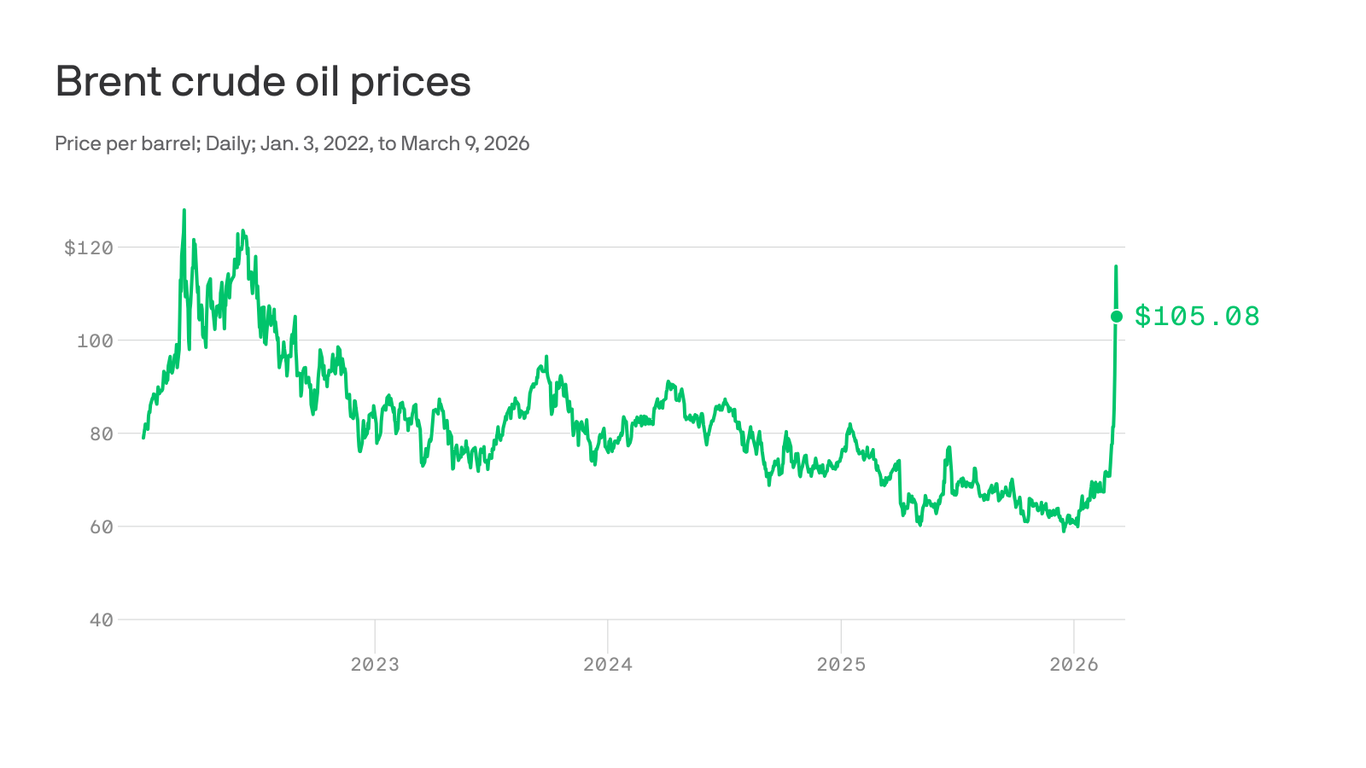
Oil surged ~25% overnight to just under $120/bbl (Brent approached $120) and global crude futures were about $107 (+15% since Friday, +47% vs 10 days prior). Analysts cite roughly 20% of global oil supply disrupted, S&P 500 futures are down ~1.3% and Asian markets plunged (Nikkei -5.2%, KOSPI -6%), while Polymarket U.S. recession odds rose to 38% from 24%. Rapidly higher energy prices threaten to boost inflation and curtail U.S. consumer spending, raising the risk of a broader global slowdown despite possible coordinated reserve releases.
Winners are the parts of the energy complex that can flex production or control transportation — fast-response US shale operators, spot tanker owners, and P&I/war-risk insurers — because route disruption and insurance premia compound realized cash margins faster than large majors can reallocate barrels. Losers in the near term are consumer-facing cyclicals (discretionary retail, leisure, airlines) where fuel-driven wallet pressure and higher operating fuel costs compress margins within 4–12 weeks; expect revenue mix shifts toward essentials and away from big-ticket items.
Second-order supply-chain effects will show up as higher freight/ad hoc shipping rates and longer lead times for containerized flows that normally transit the Gulf; manufacturers with high energy intensity (petrochemicals, primary aluminum, desalination-dependent industries) face localized shutdown risk and potential contract performance pressure. If the disruption persists beyond a quarter, corporate cost passthrough will widen input-output spreads and push nominal wages/hours worked dynamics into the Fed’s decision window, increasing the probability of a policy-driven re-rating of equities.
Key reversals: coordinated strategic reserve releases, a rapid diplomatic de-escalation, or a significant OPEC+ supply response can unwind the squeeze in days-to-weeks; conversely, escalation or a protracted blockade shifts the shock from tactical to structural with multi-quarter re-routing costs and permanent capex reallocation in shipping and refining. Tail-risk to monitor: an insurance-market blowout or formal maritime exclusion zones that materially raise voyage cycles and create sustained backwardation in specific freight and crude differentials.
Consensus is focused on headline supply loss; it under-weights the speed at which time-charter and insurance rates re-price trade costs and how that propagates into margins beyond simple fuel passthrough. That argues for selective, hedged exposure — capture the energy upside while explicitly hedging consumer/demand sensitivity and event risk rather than blanket long energy or blanket short cyclical equities.
AI-powered research, real-time alerts, and portfolio analytics for institutional investors.
Request DemoOverall Sentiment
strongly negative
Sentiment Score
-0.70
