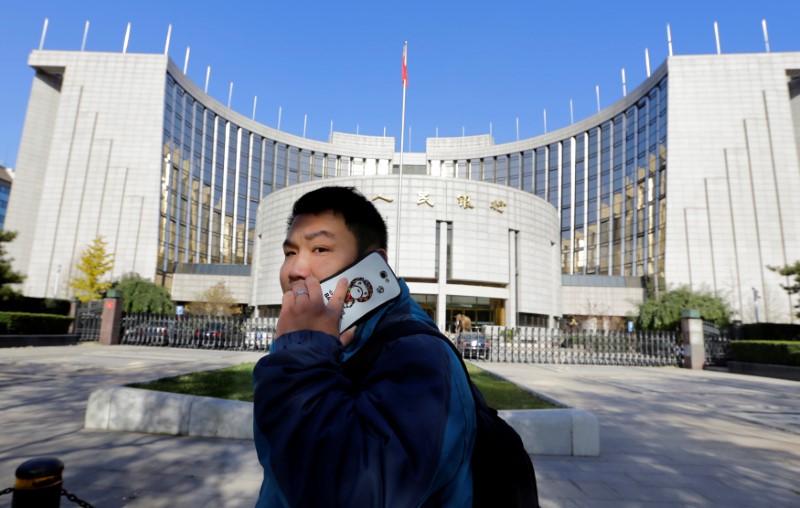
China’s central bank is tightening oversight and explicitly targeting "involution-style" competition, signaling stricter compliance and governance standards across the financial sector. The PBOC also reiterated efforts to manage LGFV debt and stabilize small and medium-sized financial institutions, pointing to a more disciplined, slower-growth banking environment. The message is risk-off for Chinese financials and credit-sensitive institutions, though the article is more policy signaling than an immediate market shock.
This is a negative read-through for balance-sheet levered financials, but the second-order effect is that tighter discipline in China tends to shrink the pool of easy credit and push capital toward infrastructure, AI, and strategic industrial policy names with cleaner funding access. The near-term winners are not banks themselves but borrowers that can refinance through policy channels while weaker lenders lose pricing power and deposit franchises. Expect the biggest alpha in domestically exposed smaller institutions, where compliance costs and capital add-ons can compress ROE by several hundred bps over the next 2-4 quarters.
The market is likely underestimating how anti-"involution" rhetoric changes underwriting behavior: once regulators signal that reckless competition is a policy target, banks, insurers, and regional lenders usually tighten credit faster than headline loan growth suggests. That has a lagged impact on credit creation, then on property-adjacent collateral values, then on local fiscal accounts; the transmission is slow, but the risk is convex over 6-12 months. For global investors, this usually means lower earnings quality in financials and more state-directed allocation into non-financial champions rather than a broad cyclical boost.
The contrarian angle is that this may be less bearish for the system than the headline implies because Beijing is effectively choosing stability over growth volatility, which can reduce tail risk premia in sovereign and bank paper even as it caps upside. If enforcement is measured, the trade becomes a dispersion story rather than a macro short: weak regional banks and shadow-credit intermediaries underperform, while top-tier national banks and policy-linked credits trade relatively better. The real reversal signal would be an easing of rhetoric or fresh growth support that forces regulators to tolerate more credit creation; absent that, the policy path looks sticky for months rather than days.
AI-powered research, real-time alerts, and portfolio analytics for institutional investors.
Request DemoOverall Sentiment
mildly negative
Sentiment Score
-0.15
Ticker Sentiment
