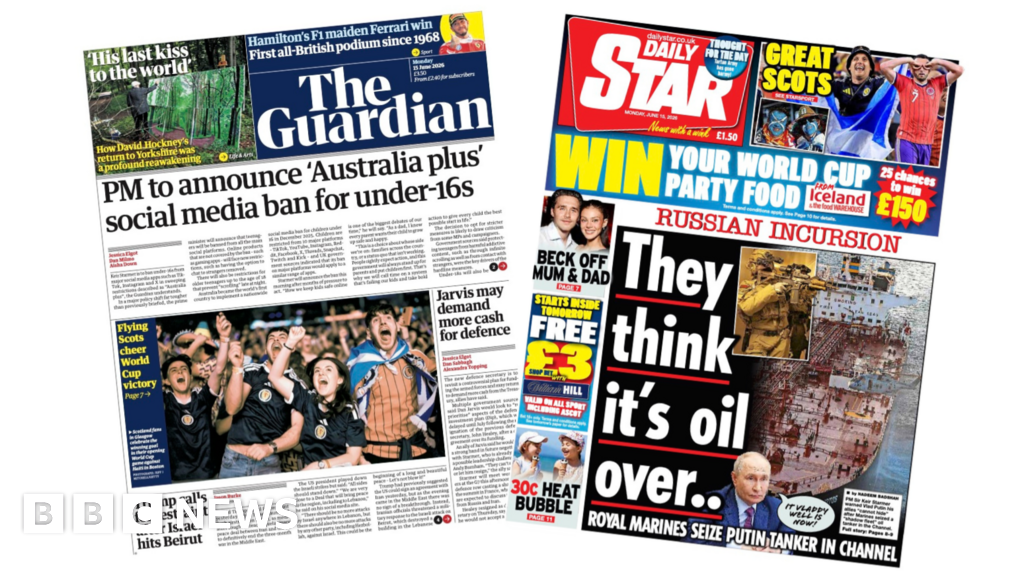
The article is a front-page roundup led by Sir Keir Starmer's expected under-16 social media ban, a major policy shift that would go beyond Australia's rules by covering chatbots and potentially imposing a curfew on 16- to 18-year-olds. It also highlights the Royal Marines' boarding of a sanctioned Russian oil tanker in the English Channel, with the vessel to be held and monitored off England's south coast as investigations continue. Other items include the Makerfield by-election, Lewis Hamilton's Ferrari win, and a tornado warning that forced the England team into lockdown.
The cleanest market read is that this is more about policy velocity than policy detail: a restrictive online-safety package, if implemented broadly, raises compliance costs for every consumer platform with youth engagement, but the equity impact is likely uneven. The companies most exposed are the ones whose growth models depend on frictionless onboarding and high-frequency engagement among minors; the bigger second-order beneficiary is likely to be incumbents with stronger identity, moderation, and parental-control tooling, because regulation tends to entrench scale advantages rather than eliminate demand.
For RACE, the headline is almost certainly noise. The only real channel is sentiment spillover from the broader macro mix: stronger domestic regulation and defense rhetoric can support “quality defensives” relative to long-duration growth, but there is no direct earnings linkage. In the current setup, the more interesting market reaction is in adjacent ad-tech / social media names, where the risk is not immediate revenue loss but a step-up in age-verification, chatbot moderation, and liability costs over the next 6-18 months.
The geopolitical piece is more market-relevant in the near term than it looks. Boarding a sanctioned vessel signals a willingness to escalate enforcement, which can tighten the implied risk premium on shadow-fleet logistics and on any insurer, broker, or shipper with ambiguous compliance exposure. Over days to weeks, this can support energy and defense names, but the bigger medium-term catalyst is whether this becomes a template for wider seizure/inspection activity; if so, expect higher freight vol, wider compliance spreads, and more headline-driven dislocations in European energy transport.
Contrarian takeaway: the market may be underpricing how quickly a broad under-16s ban could morph into a de facto digital identity regime, which would favor platform incumbents and verification vendors over smaller apps. Conversely, the crackdown narrative could be overbought for pure ad-exposed social names if enforcement is slow and litigation-heavy. The right trade is to own the picks-and-shovels of compliance, not the policy headline itself.
AI-powered research, real-time alerts, and portfolio analytics for institutional investors.
Request DemoOverall Sentiment
neutral
Sentiment Score
-0.05
Ticker Sentiment
