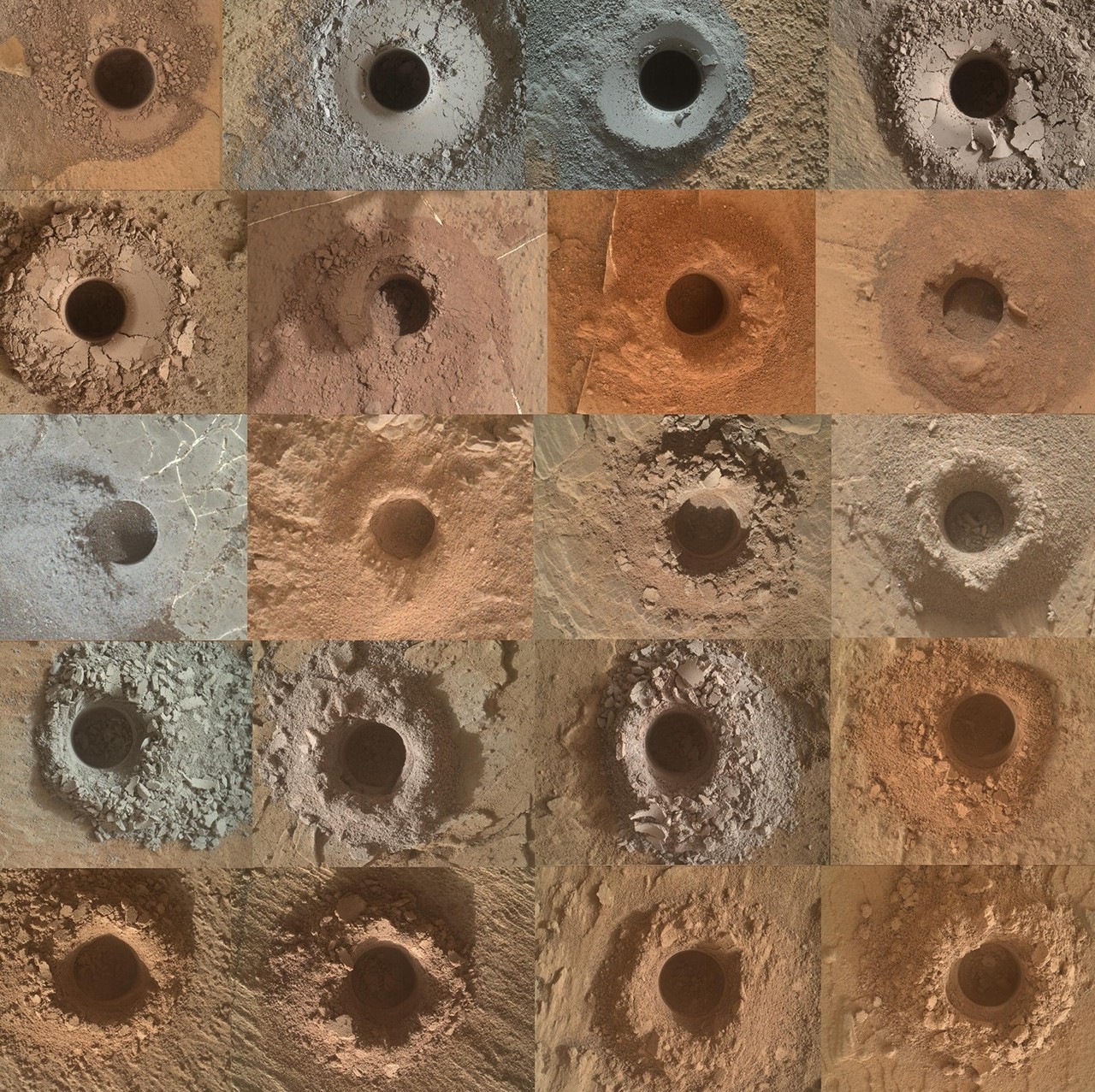
NASA’s Curiosity rover analysis of 20 Gale Crater samples found that hematite crystallite size changes with elevation, with larger crystals up to 65 nanometers in lower layers and smaller crystals under 10 nanometers in higher layers. The data also showed goethite present at higher elevations but absent in lower ones, suggesting long-lived warm groundwater and potentially habitable conditions for up to 4.7 million years in Mars’ buried rocks. The article is a scientific update with no direct financial or market-moving implications.
This is not a direct equity event, but it matters for the capital stack around planetary science, robotics, and autonomy. The key takeaway is that high-fidelity in-situ mineralogy can extract timing signals that remote sensing cannot, which strengthens the investment case for instruments and mission architectures that trade payload mass for analytical depth. In practice, that favors suppliers of space-qualified detectors, sample handling systems, and precision robotics over broad “space theme” names that depend on launch cadence alone.
The second-order implication is for Mars exploration budget durability. A result that materially upgrades the scientific value of a single rover de-risks future funding for subsurface access, drilling, and sample-return adjacencies; that is a longer-cycle tailwind for NASA contractors with mineralogy, spectroscopy, autonomy, and contamination-control exposure. The commercial spillover is modest near term, but over 2-5 years it supports a premium for companies whose hardware can prove subsurface habitability claims rather than just image terrain.
Contrarian view: the market often overvalues headline science and undervalues instrument scarcity. If the next missions remain constrained by mass, power, and thermal budgets, demand concentrates in a few prime integrators while specialist sensor vendors capture the real optionality. The risk is that without a new flagship Mars budget line or sample-return milestone, this remains a narrative event with limited revenue translation; the catalyst is not the paper itself, but a mission solicitation that explicitly rewards mineralogical fidelity and deep-subsurface access.
For ESG/climate, the analogy is more important than the asset class: mineral texture as a climate proxy reinforces the value of geologic data in extreme-environment monitoring, but it does not move policy or carbon markets by itself. Any tradable effect would likely come via funding expectations for Earth-observation tools and autonomous science platforms, not from Mars sentiment per se.
AI-powered research, real-time alerts, and portfolio analytics for institutional investors.
Request DemoOverall Sentiment
neutral
Sentiment Score
0.05
