
A foundation model for the Earth system
Source: Nature
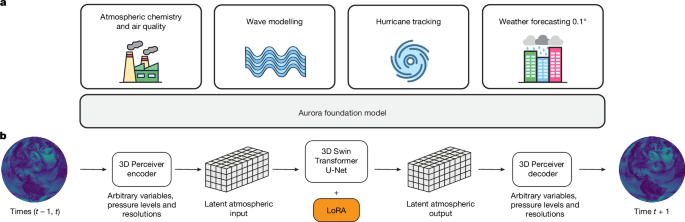
Researchers have introduced Aurora, a large-scale AI foundation model trained on extensive geophysical data, which significantly outperforms existing operational forecasting systems in air quality, ocean waves, tropical cyclone tracking, and high-resolution weather predictions, while operating at a fraction of the computational cost; specifically, Aurora surpasses operational forecasts in air quality on 74% of targets, ocean waves on 86%, tropical cyclone tracks on 100%, and high-resolution weather on 92%, suggesting a transformative potential for AI in democratizing access to accurate and efficient environmental forecasting across diverse applications.
Analysis
The development of Aurora, a large-scale AI foundation model, marks a significant advancement in Earth system forecasting, demonstrating superior predictive performance over established operational systems across multiple critical domains at substantially reduced computational expense. Trained on over one million hours of diverse geophysical data, Aurora outperforms existing methods in 5-day global air pollution forecasts (surpassing on 74% of targets), 10-day global ocean wave forecasts (exceeding on 86% of targets), 5-day tropical cyclone track forecasts (outperforming seven operational centers on 100% of targets, with notable 20-25% improvements at 2-5 day lead times), and 10-day global weather forecasts at an unprecedented 0.1° resolution (surpassing state-of-the-art numerical models on 92% of targets). A key innovation is its foundation model architecture, which, after an intensive pretraining phase, allows for rapid fine-tuning (4-8 weeks) for specialized tasks with modest data and computational cost, yielding significant performance gains—for instance, a 54% improvement for air pollution models trained from scratch. This efficiency is exemplified by Aurora generating air pollution predictions approximately 100,000 times faster than traditional systems like CAMS. While currently reliant on traditional data assimilation for initial conditions, Aurora's scalability and adaptability suggest a transformative potential for democratizing access to high-quality climate and weather information, paving the way for broader applications in diverse sectors from agriculture to disaster management.
AllMind Terminal
AI-powered research, real-time alerts, and portfolio analytics for institutional investors.
Request TrialMarket Sentiment
Overall Sentiment
Positive
Sentiment Score
0.80
Ticker Sentiment
Key Decisions for Investors
- Investors should evaluate companies in sectors highly sensitive to environmental forecasts, such as agriculture, insurance, renewable energy, and logistics, for their preparedness to leverage advanced AI-driven prediction tools like Aurora, which could create significant operational efficiencies or new risk-opportunity profiles.
- Monitor technology companies, particularly those with significant AI research capabilities and cloud infrastructure like Microsoft (whose researchers co-authored the study and whose infrastructure was utilized), for advancements in and potential commercialization of such specialized foundation models, as they represent a substantial technological lead indicated by the positive sentiment.
- Consider the long-term disruptive impact on incumbent providers of traditional numerical weather prediction services and associated high-performance computing resources, given that AI models like Aurora demonstrate the potential for superior performance at orders of magnitude lower computational cost.
- Explore opportunities in ventures aiming to utilize the enhanced accessibility and fine-tuning capabilities of sophisticated, cost-effective environmental forecasts to serve niche markets or develop novel applications, potentially opening new value streams in areas like localized disaster prediction or optimized resource management.
More News
- Broadcom to lend Anthropic up to $42 billion to lease its chips, filing says
- Amazon pledges $1B to data center communities, warns that local opposition threatens U.S. AI lead
- Broadcom starts amassing $60 bln to fund chips for Anthropic- Bloomberg
- One of our most recent defensive buys cleared a hurdle and its stock jumped
- Exclusive-Broadcom to lend Anthropic up to $42 billion to lease its chips, filing says
- Google unveils latest AI model, but Wall Street wants a breakout personal agent