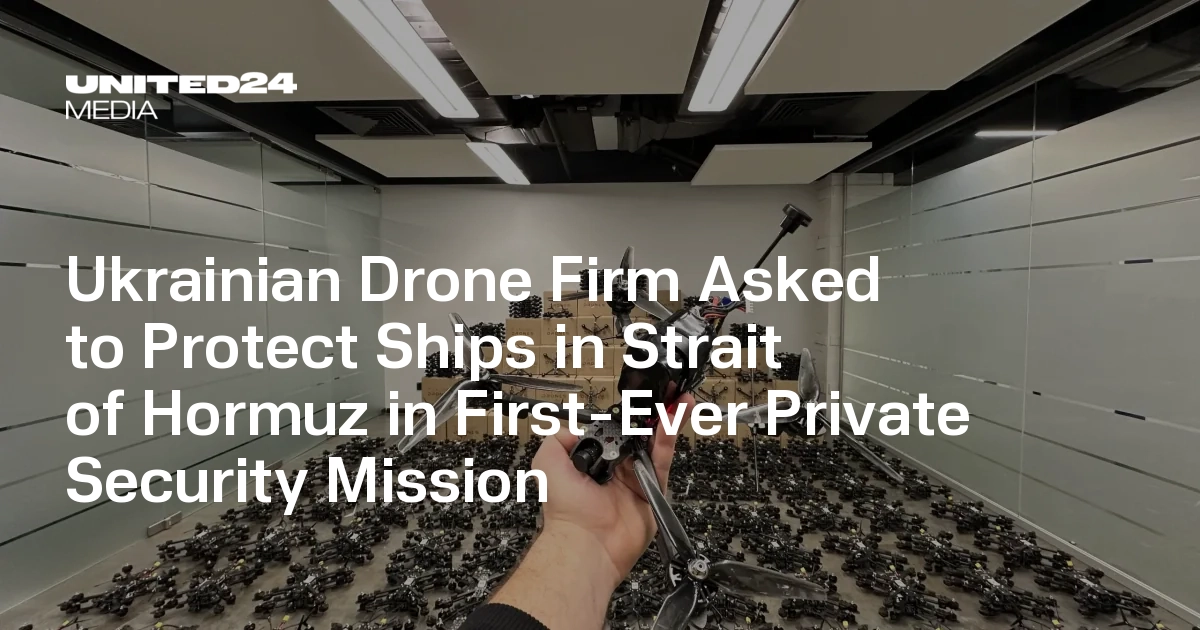
A Ukrainian defense firm received a request to provide counter-drone protection for a commercial vessel transiting the Strait of Hormuz, marking the first known private Ukrainian maritime security mission in the Middle East. TAF Industries has not yet sought Ukrainian export approvals, and the arrangement remains preliminary pending export-control and military-technical cooperation authorization. The story highlights expanding Ukrainian defense services abroad amid heightened geopolitical and shipping-route risk.
This is less about a one-off security contract and more about the monetization of battlefield capabilities into a repeatable export service. If private firms can legally package counter-UAS, EW, and armed escort functions as “military services,” the addressable market extends beyond Ukraine’s supply chain into maritime insurers, shipowners, and energy traders pricing transit risk in chokepoints. The second-order winner is not just the contractor but any European production node, because it decouples exportable know-how from domestic Ukrainian manufacturing bottlenecks and lowers political friction versus shipping finished weapons.
The near-term catalyst is insurance repricing. Even a handful of successful high-profile transits can compress war-risk premiums and create a new benchmark for private convoy protection in the Gulf, Red Sea, and Eastern Med. That creates a potential demand flywheel for counter-drone hardware, interceptor inventories, and onboard integration services, but it also raises a procurement bottleneck: these services are labor-intensive and capacity-constrained, so revenue scales slower than headlines suggest. The market may be overestimating the speed at which a niche advisory mission becomes a recurring revenue stream.
The main risk is regulatory reversal. Approval delays or a denial from export-control authorities would puncture the narrative and likely de-rate the perceived transferability of Ukrainian defense IP abroad. There is also escalation risk: if escorts become standard, adversaries can adapt quickly with saturation, decoys, or asymmetric attacks, forcing higher spend per protected transit and reducing ROI for shipowners within one to two quarters. The contrarian view is that this may ultimately benefit large Western primes and integrators more than small Ukrainian firms, because compliance, liability, and global support requirements tend to consolidate contracts toward incumbents once the market proves real.
AI-powered research, real-time alerts, and portfolio analytics for institutional investors.
Request DemoOverall Sentiment
neutral
Sentiment Score
0.10
