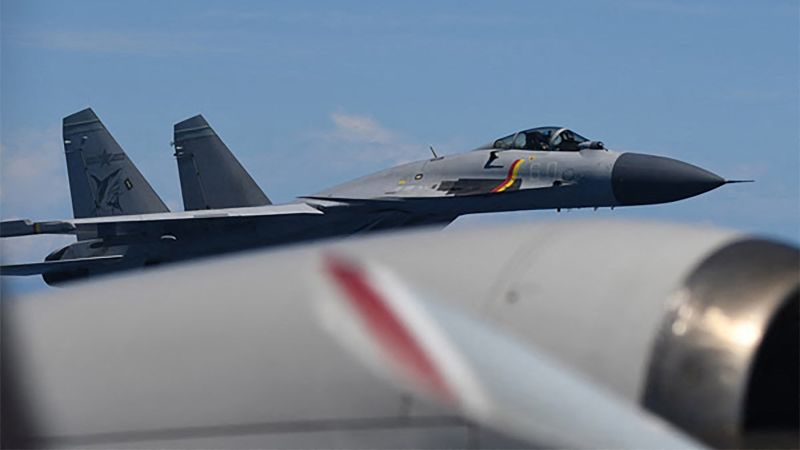
A Chinese fighter jet came within 150 feet of a Japanese reconnaissance plane over international waters in the Pacific, prompting criticism from the US Ambassador to Japan who called the action "dangerous" and "reckless." The Japanese Defense Ministry reported two close encounters over the weekend between Chinese military aircraft and Japanese planes, raising concerns about potential accidental collisions. These incidents occurred as China sent two aircraft carrier groups to the region for training exercises, which the Chinese military claims are routine and compliant with international law, but the US views as part of a pattern of aggressive behavior towards its neighbors in the Indo-Pacific region.
The recent close encounter between a Chinese J-15 fighter jet and a Japanese P-3C Orion reconnaissance aircraft, where the Chinese jet approached within approximately 150 feet of the Japanese plane over international waters in the Pacific, signifies an escalation in regional military interactions and has drawn sharp condemnation. Japan's Defense Ministry explicitly warned that such 'unusual approaches by Chinese military aircraft could lead to an accidental collision,' noting another incident where a Chinese warplane passed 900 meters directly in front of a Japanese P-3C. This concern was amplified by the US Ambassador to Japan, George Glass, who labeled the maneuver 'dangerous' and 'reckless,' framing it as consistent with 'Beijing’s ‘good neighbor’ efforts' and a broader pattern of 'reckless aggression,' citing alleged harassment of Philippine ships and Vietnamese fishermen. This assessment aligns with US Defense Secretary Pete Hegseth's recent statements at the Shangri-La Dialogue, describing a pattern of China harassing and trying to intimidate its neighbors, challenging sovereignty and freedom of navigation with actions like illegal boardings and militarizing lands. While China's PLA Navy spokesperson, Senior Capt. Wang Xuemeng, stated the deployment of two aircraft carrier groups for training exercises was 'routine,' aimed at improving mission fulfillment, and compliant with international law, the 'strongly negative' sentiment (score -0.7) and 'pessimistic' tone surrounding these events, coupled with a moderate market impact score of 0.55, underscore the heightened geopolitical risks and the potential for miscalculation in the Indo-Pacific region.
AI-powered research, real-time alerts, and portfolio analytics for institutional investors.
Request DemoOverall Sentiment
strongly negative
Sentiment Score
-0.70
