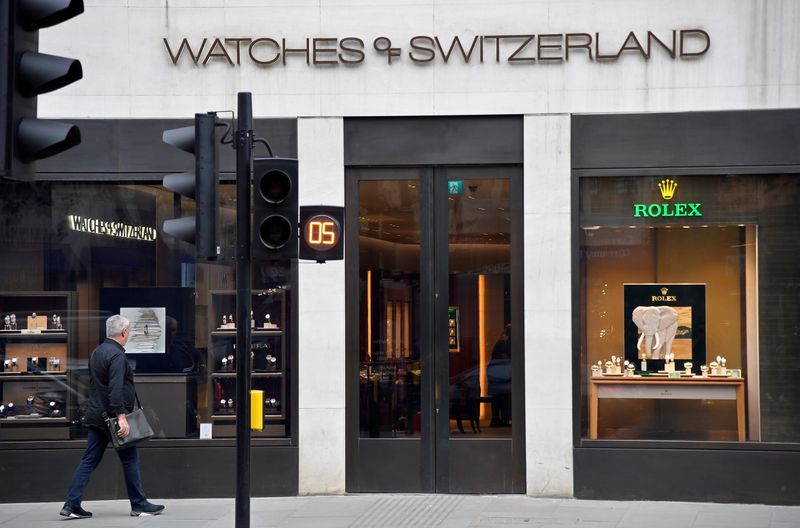
Watches of Switzerland reported stronger H1 results with pretax profit rising to £61m from £41m a year earlier, revenue of £845m (up 10% at constant currencies), adjusted EBITDA of £91m (from £87m) and EBIT of £68.5m marginally above consensus of £68.1m and the company’s guided range. Management said the U.S. — now nearly 60% of profitability — remained the key growth driver, reiterated its fiscal 2026 outlook, and highlighted a recent U.S. tariff cut on Swiss goods (from 39% to 15%) as a positive industry development that should improve visibility for retailers and suppliers.
Market structure: The tariff cut from 39% to 15% materially lowers effective landed costs for Swiss-made watches into the U.S., directly benefiting Watches of Switzerland (WOSG.L), Swiss suppliers and luxury brands that sell through U.S. retail channels. Expect incremental margin expansion of 100–300 bp over 6–12 months if brands pass savings to retailers or if absorption improves volumes; domestic UK-focused and mid-market retailers are the relative losers as discretionary spend re-allocates to luxury. Cross-asset: stronger luxury retail receipts can modestly lift risk assets and push sovereign spreads tighter on growth sentiment; CHF/USD and USD strength are key cross-currents — a stronger CHF would negate some tariff gains.
Risk assessment: Tail risks include a rapid reversal in U.S. consumer spending (retail sales shock), CHF appreciation wiping margin gains, or aggressive brand-direct strategies that bypass multi-brand retailers — each could erase >50% of the embedded near-term upside. Immediate (days) risk is post-release sentiment and IV swings; short-term (weeks/months) risks are holiday sell-through and inventory accumulation; long-term (quarters) depends on sustained margin capture and competitive positioning. Hidden dependencies include supplier production capacity constraints and grey-market arbitrage which could compress retailer margins even as topline grows.
Trade implications: Primary trade is long U.S.-exposed luxury retailers (WOSG.L) into the holiday cadence and tariff clarity, financed by trimming UK domestic retail exposure (e.g., NXT.L). Use calibrated options (debit call spreads) to express asymmetric upside into the December–March window while protecting against a consumer slowdown. Monitor three operational catalysts: monthly sell-through vs inventory (target sell-through >90% of plan), quarterly gross margin +100–300 bp, and CHF/USD moves; any divergence should trigger revaluation.
Contrarian angles: Consensus focuses on straightforward margin upside; underappreciated is the possibility that tariff cuts increase import volumes and competition, pressuring resale values and used-market pricing, which could hurt new-watch ASPs over 12–24 months. The market may be underpricing inventory risk — if WOSG reports inventory days up >10% YoY over the next quarter, the bullish case is weakened. Historical parallels: tariff or trade-cost reductions often boost volumes but compress channel margins initially; expect similar mixed outcomes here.
AI-powered research, real-time alerts, and portfolio analytics for institutional investors.
Request DemoOverall Sentiment
moderately positive
Sentiment Score
0.48
Ticker Sentiment
