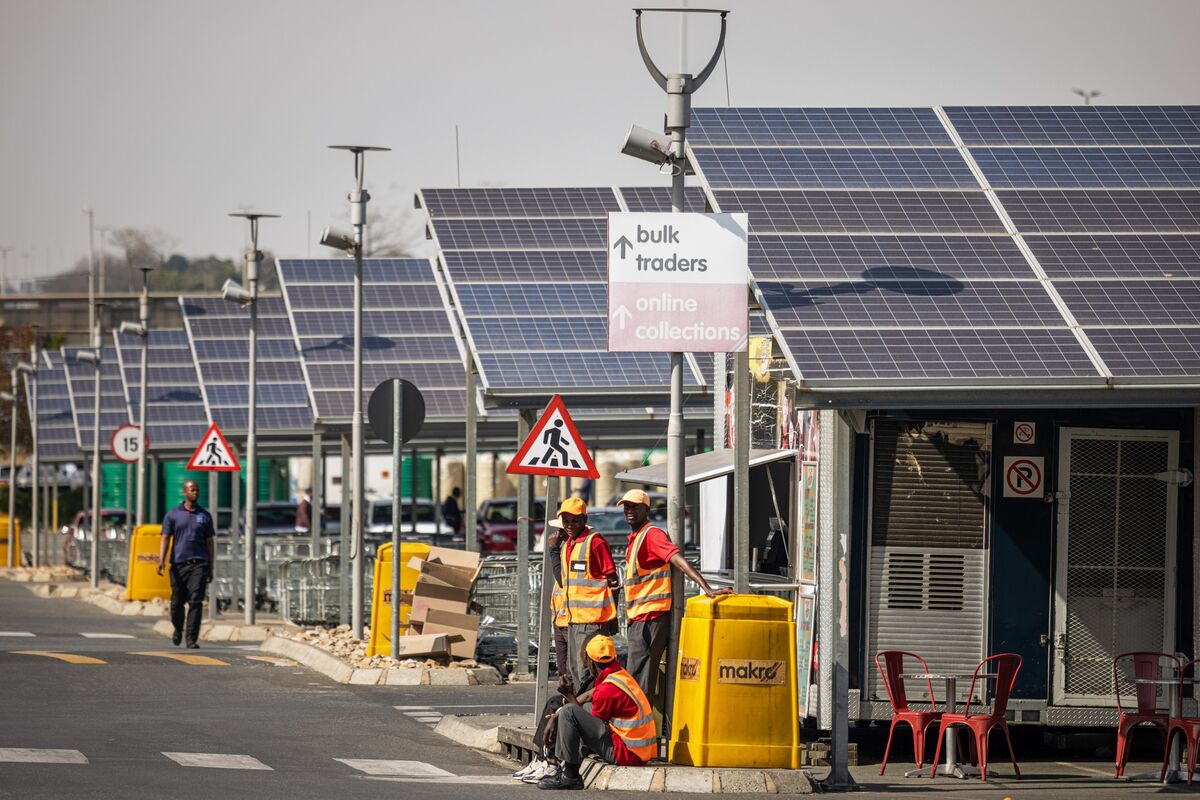
Johannesburg-based Verdure Fund, backed by German development bank KfW, sold 229 million rand (~$13m) of bonds on Nov. 7 backed by loans to 159 rooftop solar installations and plans a further issuance in Q1 next year. The fund aims to issue at least 300 million rand of similar securities annually for the next decade, signalling a sustained pipeline for green asset-backed securities in South Africa and expanding local financing avenues for small-scale solar projects.
Market structure: Verdure’s maiden 229m ZAR ABS and plan for ~300m ZAR/year (~$17m/year) shifts capital toward small-scale solar securitisation in South Africa, benefiting rooftop installers, specialised asset managers, and foreign development-bank liquidity providers (KfW). Incumbent centralized generators and fuel-focused firms face marginal demand loss for wholesale kilowatt-hours and diesel back-up; impact on national power mix is gradual — expect share shifts measured in single-digit percentage points over 3–5 years. Pricing power: repeated annual issuance creates a benchmark for SA green ABS spreads (initially likely 150–350bps over sovereign), compressing funding costs for similar projects and crowding in private capital. Cross-asset: modest supportive flow for ZAR FX and SA credit curves (local ABS demand offsets some sovereign supply), limited commodity impact other than slightly lower short-run diesel demand in localized segments.
Risk assessment: Tail risks include a regulatory rollback of rooftop incentives, spike in household default rates during load-shedding-driven income shocks, or withdrawal of KfW/backer support; any of these could double loss assumptions and widen ABS spreads by 300–700bps. Time horizons: immediate (days) — minimal market reaction; short-term (weeks–months) — new issuance cadence and pricing discovery; long-term (years) — potential sector growth if installation pipeline scales to >3bn ZAR (~$170m) cumulatively. Hidden dependencies: credit performance tied to municipal billing/collection efficiency and frequency of load-shedding; ABS value crystallises only if servicing and lien structures are robust. Catalysts: faster permitting reform, additional DFIs entering deals, or sovereign green bond frameworks will accelerate issuance; adverse court rulings or subsidy cuts would reverse momentum.
Trade implications: Direct plays — establish tactical 2–3% NAV exposure to EM green ABS via green-bond ETFs (e.g., VanEck GRNB) and to SA equity beta via EZA (0.5–1% overweight) to capture re-rating if issuance scales; size positions to loss limits of 30–40bps NAV movement. Relative trades — pair long senior tranches of green ABS versus short unsecured corporate credit in same region (target 150–250bps spread capture), or long ZAR forwards (3m) vs short USD up to 0.5% NAV if monthly issuance >25m ZAR sustained for two consecutive quarters. Options — buy 3–6 month ZAR call spreads (USD/ZAR) to express funding-flow skew while limiting downside; consider buying credit-protection (5y CDS) on small listed SA utilities if regulatory risk rises. Sector rotation — trim 1–2% exposure to high-emission energy majors (e.g., Sasol SSL) over 12 months and redeploy into renewable installers/servicers.
Contrarian angles: Consensus treats Verdure’s program as niche; missing is that repeatable, bankable ABS issuance creates an investable curve and standardised legal precedents — a non-linear step-change that can lower funding costs by 100–200bps within 18 months. Reaction may be underdone: pricing currently understates collection and municipal-receipt risk; absent strong servicer covenants, realized defaults could spike and outsize loss to junior tranche holders. Historical parallels: early US residential solar securitisations (2010s) initially outperformed but later repriced after operational shocks — expect similar dispersion of returns across tranche seniority. Unintended consequences: aggressive issuance without strong servicing frameworks could sour investor appetite for all SA ABS, widening EM spreads; stress-test positions for 500–700bps spread widening scenario within 12 months.
AI-powered research, real-time alerts, and portfolio analytics for institutional investors.
Request DemoOverall Sentiment
mildly positive
Sentiment Score
0.32
