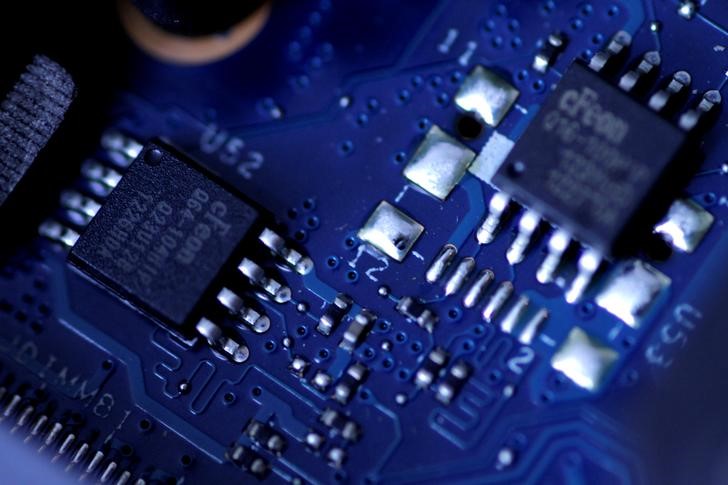
Asian chip stocks sold off sharply as the AI trade lost momentum, with SK Hynix down 5.4%, Samsung Electronics down 2%, SoftBank down 6.8%, and several Japanese chip names falling 5.7%-8%. The KOSPI plunged as much as 8.8% and the Nikkei 225 dropped nearly 4% as investors rotated out of AI-fueled winners. The move was amplified by rising Middle East tensions, weak Broadcom earnings, and higher U.S. Treasury yields after stronger-than-expected payrolls data.
The key shift is not that AI demand disappeared, but that positioning got too crowded relative to near-term macro. When a sector trades like a quasi-duration asset, a move up in real yields plus any geopolitical shock forces the same unwind mechanism: de-grossing by systematic funds, then discretionary profit-taking, then dealer hedging amplifying the selloff. That means the first leg down can overshoot fundamentals by 5-10% before buyers return, especially in the most crowded AI beneficiaries with the highest beta to sentiment.
The relative winners in this tape are less obvious than the losers: companies with AI exposure but lower valuation sensitivity, recurring software-like revenue, or actual monetization visibility should outperform pure hardware beta. Within semis, the market is now punishing the second derivative of AI enthusiasm more than it is repricing long-term demand, so foundry and memory names can gap lower even if hyperscaler capex remains intact. That creates a temporary spread between “AI infrastructure demand” and “AI narrative premium,” and the latter is what is deflating.
The bigger second-order risk is that higher Treasury yields shorten the time horizon investors are willing to pay for AI growth; this is a multiple problem before it is an earnings problem. If yields stay elevated for several sessions, expect continued pressure on high-P/E AI proxies and reduced appetite for IPOs and secondary offerings in the broader tech ecosystem. The geopolitical overlay matters because it keeps volatility bid, which encourages selling of winners into strength rather than dip-buying, extending the unwind over days to weeks.
The contrarian angle is that this may be an air pocket, not a regime change: enterprise AI spending is still early, and the most profitable trade after a sentiment flush is often to buy the highest-quality enablers once forced selling exhausts. The market is likely conflating near-term price action with medium-term demand elasticity. If Broadcom-style disappointment is treated as evidence of softening AI capex, that sets up a rebound when guidance from hyperscalers and memory vendors reasserts the spending cycle over the next 1-2 quarters.
AI-powered research, real-time alerts, and portfolio analytics for institutional investors.
Request DemoOverall Sentiment
strongly negative
Sentiment Score
-0.72
Ticker Sentiment
