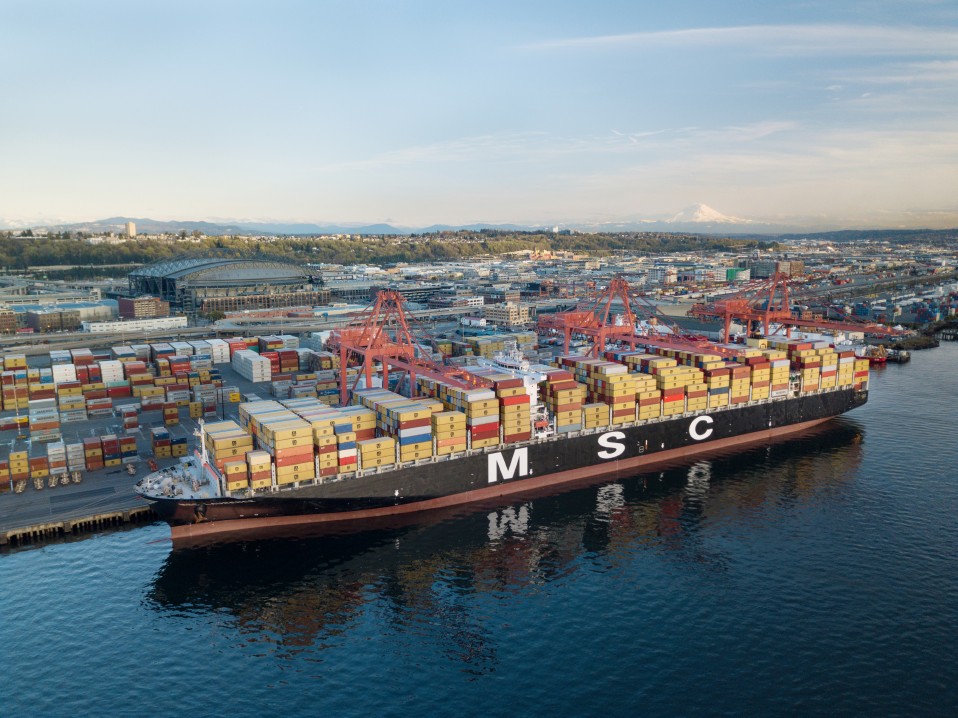
MSC announced a new Europe–Red Sea–Middle East Express service, with first sailing scheduled from Antwerp on 10 May (Voyage OC619A). The route will directly connect Europe to King Abdullah Port, Jeddah, and Aqaba, with onward multimodal links to UAE and Upper Gulf destinations, improving transit times and reliability amid Middle East disruptions. The news is supportive for shipping and logistics flows but is primarily a routine network expansion.
This is less about incremental capacity than about route arbitration: carriers are effectively monetizing the market’s willingness to pay for schedule certainty around the Red Sea/Middle East risk premium. The second-order beneficiary is any shipper with flexible routing and high-value, time-sensitive cargo, because a dedicated lane can compress working capital via lower safety stock even if freight rates remain above pre-crisis norms.
The competitive pressure is asymmetric. Rivals that still rely on longer detours or fragmented feeder networks face a yield squeeze, especially on Europe–Levant–Gulf corridors where customers will tolerate only modest premiums before substituting via air, rail, or inventory rebalancing. Over the next 1–3 months, the main effect is likely mix-driven rather than volume-driven: better load factors, tighter equipment utilization, and a mild repricing of premium service contracts rather than a broad spot-rate collapse.
The real macro watchpoint is not whether the service launches, but whether it persists through any stabilization in regional security. If the security premium fades, carriers that added dedicated capacity too early could see utilization normalize faster than yields, creating a negative operating leverage trap over 2–3 quarters. Conversely, if disruptions intensify, this becomes a durable moat for operators with the densest European port network and inland connectors, because the bottleneck shifts from sea miles to terminal reliability and hinterland execution.
Consensus may be underestimating how much of the value accrues to logistics enablers rather than ocean carriers themselves. Ports, terminal operators, and inland rail/intermodal assets stand to benefit from rerouted, more complex cargo flows, while pure container lines face the usual risk that higher headline trade volumes are offset by capex and service duplication. The better trade is to own the bottlenecks, not the ships.
AI-powered research, real-time alerts, and portfolio analytics for institutional investors.
Request DemoOverall Sentiment
mildly positive
Sentiment Score
0.15
