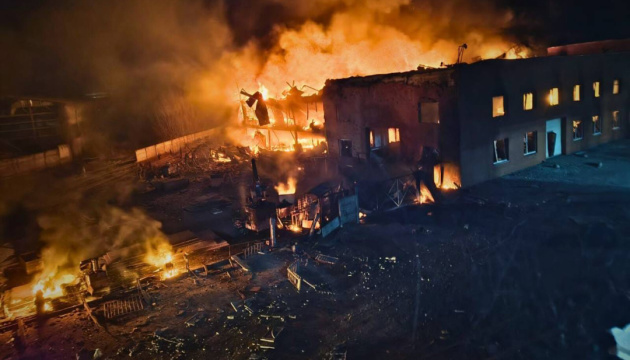
Russia launched ~430 drones and 68 missiles (including 13 ballistic) overnight on March 14; Ukrainian air defenses reportedly shot down about 58 missiles. The main target was Kyiv region energy infrastructure — four killed and 15 injured in the Kyiv region — elevating near-term risks of energy disruption and increasing urgency/demand for air-defence missiles and related defense-sector supply, which could support defense names and raise regional risk premia.
This attack accelerates an already-visible structural shift from one-off donations to sustained industrial-scale procurement of integrated air defenses, missile interceptors, and associated sensors. Europe and the US will move from emergency transfers to multi-year buy programs; given typical manufacturing lead times for guided interceptors and seeker electronics, expect real supply constraints for 6–18 months, not days, creating a multi-quarter revenue runway for prime contractors and subsystem suppliers.
A second-order consequence is spare-parts and consumables demand (propellants, fuzes, INS/GPS modules, cryo/solid motors) and logistics capacity — firms that supply niche propulsion, precision guidance, and test/acceptance services will see outsized margin expansion because scaling them requires capital equipment and certifications that are not fungible. Parallel to military procurement, attacks on energy grids accelerate demand for hardening: fast-response gensets, distributed storage, and microgrid controls (capex-heavy, multi-year replacement cycles) which underpin a different industrial bucket than typical A&D wins.
Tail risks are concentrated: a rapid diplomatic thaw or sudden large-scale production push (e.g., pan-European coordinated factory lines) would compress prices and hurt short-term option plays; conversely, escalation that forces Russian reallocation to other theaters or a collapse in missile supply from Russia would sustain Western order flow for years. Watch two catalysts in the next 30–90 days: formal EU/UK multi-year funding announcements and explicit multi-year contracts to primes (those events will re-rate equities more than nightly strike tallies).
AI-powered research, real-time alerts, and portfolio analytics for institutional investors.
Request DemoOverall Sentiment
strongly negative
Sentiment Score
-0.80
