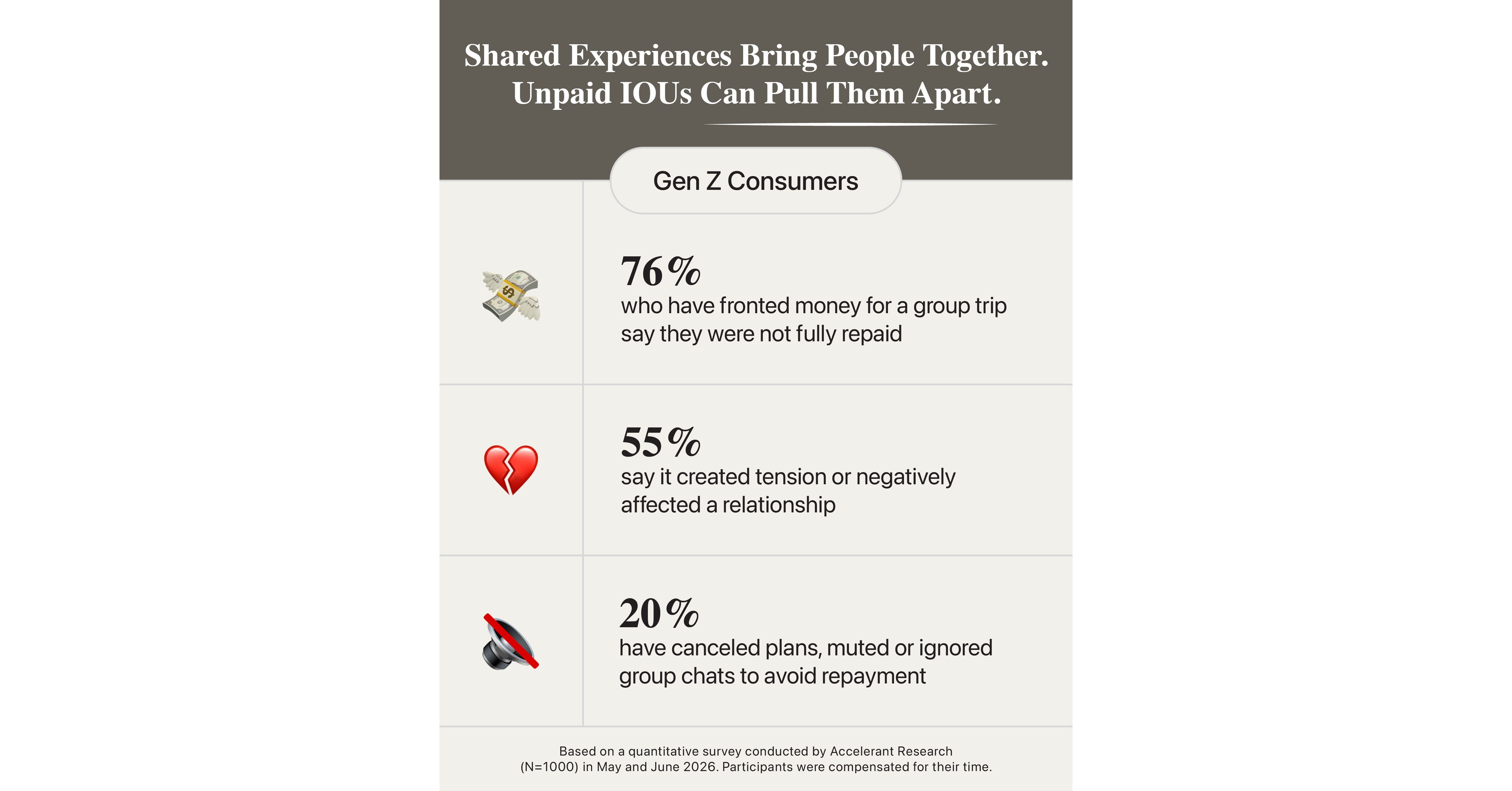
Research tied to Zelle finds 76% of Gen Z consumers who front money for group expenses are not fully repaid, and 47% report going into debt to cover shared costs. Repayment friction is common (55% report relationship tension; 33% report stress/anxiety), but Zelle users report faster, smoother settlement (80% say faster paybacks; 68% easier cost splitting; 50% less awkwardness). Overall, the news frames digital P2P payments as mitigating social/payment avoidance rather than creating new macroeconomic risk.
This is more a distribution/behavior signal than a fundamental earnings catalyst. The economically relevant takeaway is that bank-native P2P is becoming part of the default payment habit for younger consumers, which strengthens the network effect for institutions that already sit inside the primary checking relationship. That is a mild positive for large banks with dense retail ecosystems and a mild negative for standalone wallets that rely on being the default frictionless settlement layer.
The second-order effect is retention, not revenue uplift: if settlement happens inside the bank app, the bank keeps more customer engagement data, lowers the odds of app-switching, and reduces the chance that a third-party wallet becomes the “home screen” for money movement. For smaller banks, that supports deposit stickiness and digital share-of-wallet, but the financial impact is likely de minimis unless it translates into measurable transaction-frequency gains on earnings calls.
This is not enough to justify a standalone long/short today. The article is survey-driven and self-referential to the sponsor, so the burden of proof is on actual transfer volume, active users, and incremental engagement metrics. The contrarian read is that the market may be overestimating the strategic moat: Zelle can be habit-forming, but it is still a utility-like rail unless banks use it to deepen primary-account economics. Falsifier: if PayPal/Venmo and Cash App continue to outgrow bank P2P usage, this thesis should be abandoned.
On your named names, CRMT has no visible linkage; FISI is only a very small indirect beneficiary via consumer banking engagement, not a tradable earnings lever.
AI-powered research, real-time alerts, and portfolio analytics for institutional investors.
Request DemoOverall Sentiment
mildly positive
Sentiment Score
0.12
Ticker Sentiment
