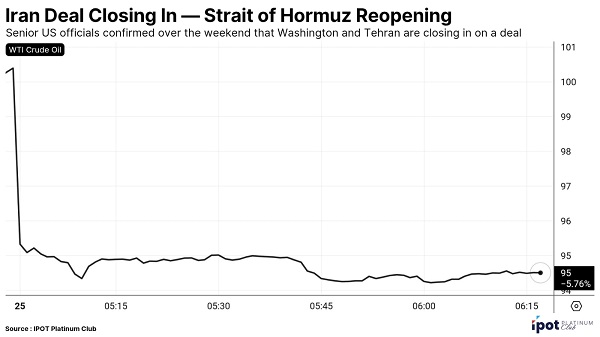
Senior US officials said Washington and Tehran are close to a deal to reopen the Strait of Hormuz, sending WTI down about 5% to $91.4 and Brent down 5% to $98.2 a barrel. The lower oil backdrop is supportive for global risk assets, weakens the dollar, and provides relief for Indonesia via a narrower current account deficit and room for Bank Indonesia to pause hikes. Near-term focus remains on US PCE inflation data, which could revive the rate-hike narrative if it comes in hot.
The immediate setup is a classic “lower tail risk, higher dispersion” trade: a de-escalation in the Strait should compress the oil risk premium, but the first-order winners are not just energy consumers. Lower crude tends to relieve pressure on the rupiah, local rates, and Indonesia’s external balance, which matters because the market has been pricing a higher probability of policy tightening and capital flight; that makes domestically exposed financials and rate-sensitive names the cleaner relative beneficiaries than the broad index.
The bigger second-order issue is timing. A relief rally into a three-session week with a long holiday closure creates a strong incentive to de-risk after Monday’s gap-up, so index level strength may coexist with weak breadth and elevated turnover in crowded longs. That means the tape can look constructive while the real opportunity is in names that were mechanically sold or de-rated on macro fear, not in chasing beta after a one-day repricing.
The real macro swing factor remains PCE: if inflation runs hot, the market will rapidly reprice the oil move as temporary and re-anchor higher US yields, which would cap the EM relief trade and keep the dollar bid. In that scenario, the market’s initial interpretation of lower oil as disinflationary is likely overstated; a hotter PCE would make the curve bear-flatten, limit risk appetite, and reduce the durability of any rally in Asia FX and cyclicals.
The MSCI deletion flow looks more interesting than the headlines imply because forced selling into a holiday-shortened week can create dislocations that reverse once passive flow is done. The key is to avoid the obvious index shorts: the better setup is buying survivors or high-quality proxies into technical pressure, while staying alert to any rating action that would turn a one-time technical event into a broader de-leveraging shock.
AI-powered research, real-time alerts, and portfolio analytics for institutional investors.
Request DemoOverall Sentiment
mildly positive
Sentiment Score
0.25
Ticker Sentiment
