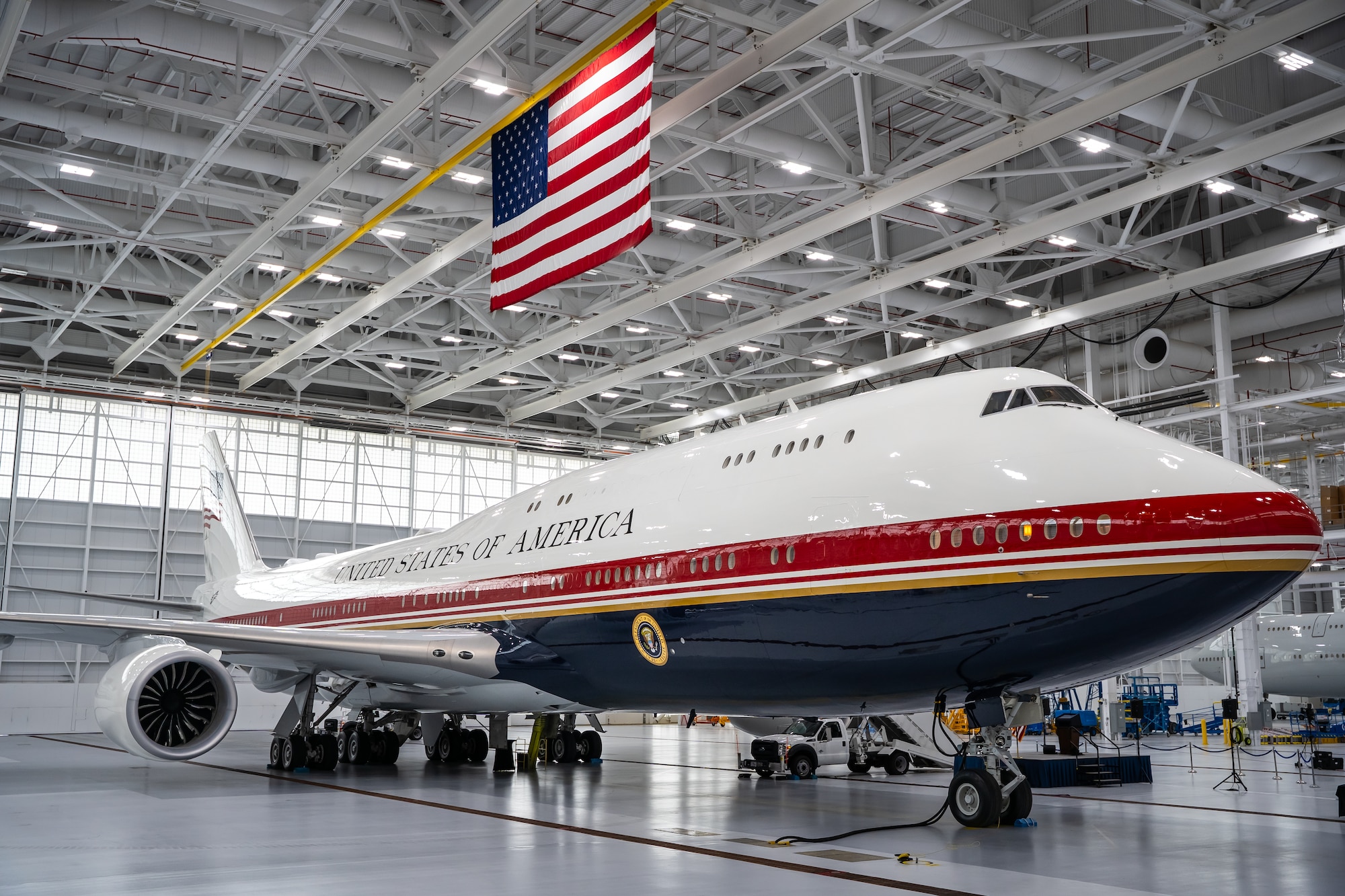
The Air Force’s VC-25B Bridge aircraft has officially arrived and will begin commissioning flights, advancing secure presidential airlift capability on an accelerated timeline. The program is intended to relieve pressure on the aging VC-25A fleet while maintaining continuity for Air Force One operations until the long-term VC-25B enters service. The article highlights completed modifications, training assets, and logistics preparation, but it is primarily a procedural delivery update with limited direct market impact.
This is less a one-off aviation headline than evidence that the program is moving from execution risk to sustainment risk. For BA, the market implication is modestly positive because the asset now has to prove repeatable reliability rather than design intent; that shifts the debate from “can Boeing deliver?” to “can Boeing support a highly customized platform on schedule?” The second-order readthrough is that any success here improves confidence in Boeing’s ability to manage complex government-modification work, but it does not automatically de-risk the commercial 747/defense backlog because the most valuable skill is not airframe manufacturing, it is integration under mission-critical constraints.
The near-term beneficiary is the broader defense/logistics ecosystem, not just the prime contractor. Training, spares, and maintenance support create a multi-year services pull that is more durable than the initial delivery event, and that favors suppliers with certification depth, obsolescence management, and secure communications expertise. A less obvious implication is that the government is signaling willingness to pay up for schedule compression when mission continuity is at stake; that can help adjacent programs where “accelerate now, optimize later” becomes the procurement template.
The main risk is that the headline creates a temporary optics premium without changing Boeing’s structural execution issues. If commissioning flights surface even minor integration or supportability problems, the stock reaction could be disproportionate because the market is already conditioned to penalize any evidence of process weakness. Over a 3-12 month horizon, the more important catalyst is whether this program reduces pressure on the legacy fleet without introducing sustainment overruns; if it does, it incrementally improves the odds of follow-on government confidence, but if it doesn’t, this becomes a case study in expensive capability theater.
The contrarian view is that the market may be underestimating how small the direct financial impact is relative to the narrative impact. This is not a meaningful revenue driver for BA on its own, so any bullish trade should be framed as sentiment/credibility beta rather than earnings alpha. The better expression is probably in names leveraged to defense services, secure systems, and maintenance content, where the second-order spend is more persistent and less headline-sensitive.
AI-powered research, real-time alerts, and portfolio analytics for institutional investors.
Request DemoOverall Sentiment
mildly positive
Sentiment Score
0.35
Ticker Sentiment
