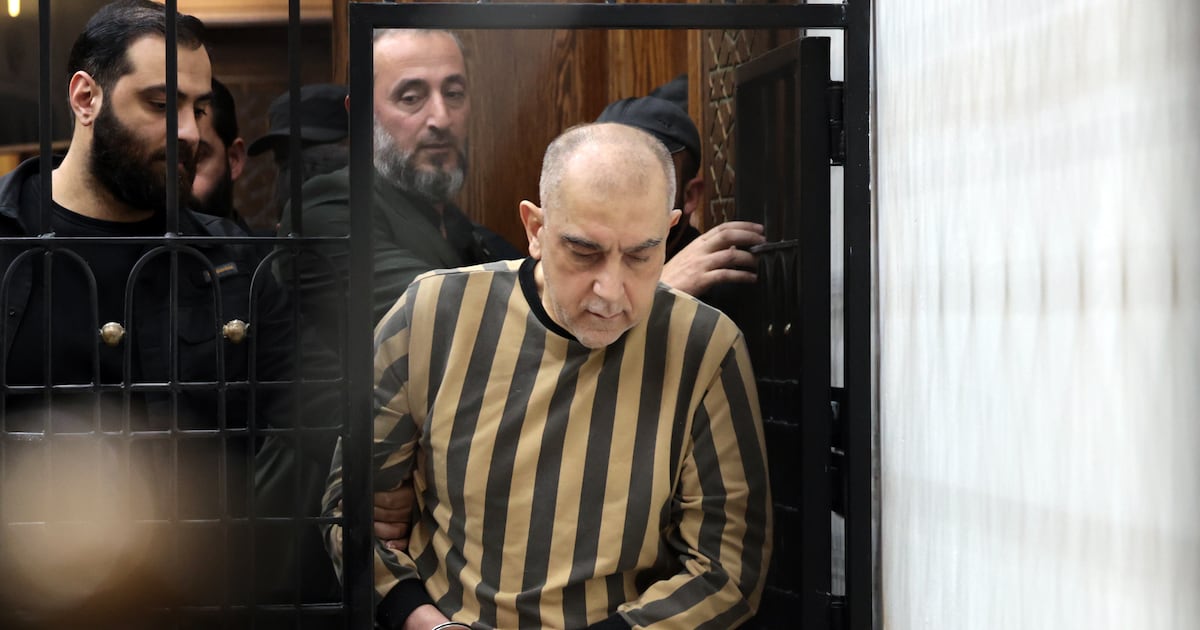
Syria has begun public trials of prominent former-regime officials in Damascus, starting with Atif Najib, the former head of political security in Deraa and a US-sanctioned figure. The government also announced the arrest of Amjad Yousef, the chief suspect in the 2013 Tadamon massacre, as part of a broader transitional justice effort after Assad family rule ended in December 2024. The article underscores ongoing accountability efforts alongside continued instability, including revenge killings and sectarian violence.
This is less a one-off legal event than the opening bid in a state-legitimacy trade. Public accountability for regime figures can improve Syria’s access to external funding and selective sanctions relief over a 6-18 month horizon, but the near-term market implication is actually higher political dispersion: the transition government is signaling control, while the country’s internal security apparatus is still fragmented. That combination usually supports narrative upside for reconstruction but delays hard capital formation because contractors, insurers, and lenders need evidence that prosecutions won’t morph into factional retaliation.
The biggest second-order risk is not the trials themselves; it is the backlash dynamic they can trigger among armed remnants, Alawite communities, and local patrons tied to the old order. If these cases are perceived as victor’s justice, expect elevated assassination risk, localized sabotage, and intermittent transport disruption in the south and around Damascus over the next few months. That matters for any early reconstruction thesis because the first beneficiaries are likely to be security, logistics, and telecom rather than heavy civil works.
The anti-Captagon push is the more investable angle. A serious crackdown on a regime-era revenue stream can improve Syria’s external posture, but it also displaces supply into neighboring routes and raises enforcement pressure across Jordan, Lebanon, and Iraq. In practice, that means an initial negative for illicit-network beneficiaries and a medium-term positive for regional border-security, surveillance, and private-security vendors if the transition government can maintain momentum.
Consensus is probably overestimating how quickly accountability converts into re-rating. Symbolic trials are necessary for normalization, but investors should assume a long verification period before any broad reconstruction spend or meaningful capital inflow. The contrarian read is that the fastest monetization is in “stability infrastructure” — checkpoints, perimeter security, communications, and forensic/legal services — not in headline reconstruction names.
AI-powered research, real-time alerts, and portfolio analytics for institutional investors.
Request DemoOverall Sentiment
mildly negative
Sentiment Score
-0.20
