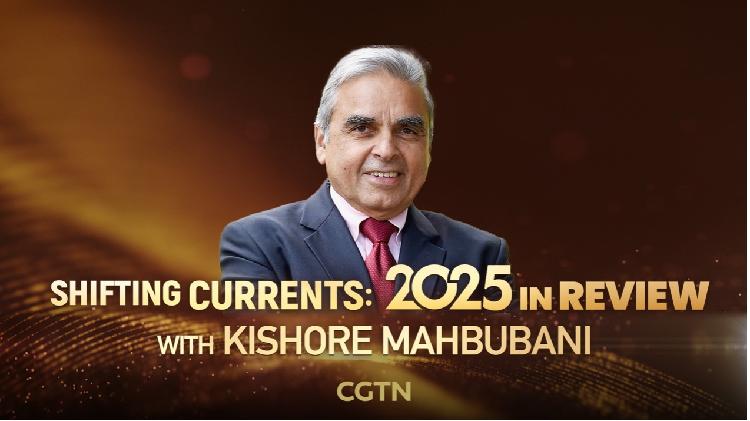
CGTN's year-end special features Professor Kishore Mahbubani reviewing 2025, highlighting that Asia — led by China — continued to drive global growth as China pursues 'high-quality' development and assumes a stabilizing role in international affairs. He frames the future trajectory of China–U.S. relations as the principal geopolitical variable for markets, implying investors should monitor bilateral engagement and regional policy signals that could influence trade dynamics, growth forecasts and risk premia.
Market structure: The headline—Asia (especially China) driving global growth—raise winners: China A-shares, Asian exporters, semiconductors and industrial metals suppliers; losers include parts of US capital goods and defense exporters if cooperation replaces rivalry. Expect relative P/E expansion in Asian equity indices (5–15% re-rating possible) and tighter spreads on Asian credit if capital flows reallocate over 6–12 months; shipping and copper demand should firm, supporting commodity prices.
Risk assessment: Tail risks include a sudden US-China political break or renewed tech sanctions causing a 15–30% drawdown in Chinese tech within days; property-sector contagion in China could shave growth by >1pp over a year. Immediate impact is likely muted; watch short-term sentiment over the next 30–90 days; structural benefits play out over 3–5 years. Hidden dependencies: commodity cycles, US policy (export controls), and onshore credit conditions; catalysts are bilateral summits, PMI/manufacturing prints, and PBOC guidance.
Trade implications: Tactical plays favor China A-shares and Asian cyclicals versus US large caps, semiconductor supply-chain exposure, and copper/miners. Use defined-risk option structures for geopolitical volatility (3–6 month call spreads on China ETFs; quarter-dated strangles only if realized vol >30%). Rotate from defensive US duration into selective EM/Asia credit if spreads compress >50bp.
Contrarian angles: Consensus still prices permanent decoupling—this underestimates scope for managed cooperation and renewed trade flows, so Asia outperformance vs US is underpriced. Overdone risks include ignoring China property and regulatory reversals; historical analogues (post-2016 re-engagement periods) show rapid re-rating can reverse quickly if growth misses. Unintended consequence: stronger Asia could push commodity inflation higher and force global policy tightening, creating a stagflation risk for commodity-importing EMs.
AI-powered research, real-time alerts, and portfolio analytics for institutional investors.
Request DemoOverall Sentiment
mildly positive
Sentiment Score
0.22
