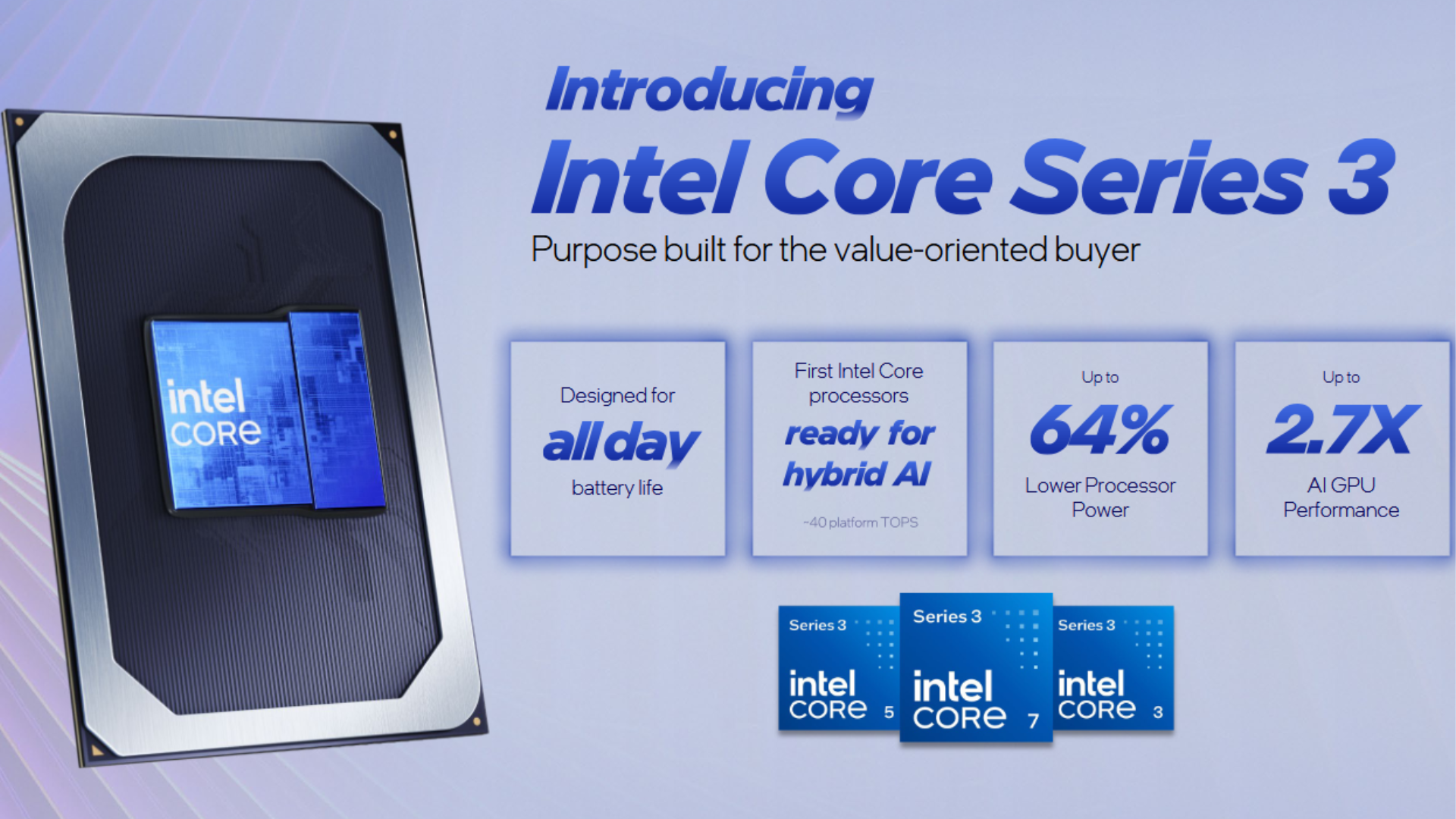
Intel launched Wildcat Lake as Core Series 3, a six-SKU value-laptop and edge lineup built on Intel 18A, with up to 40 platform TOPS and battery-life claims of 9.6 hours in Zoom, 12.5 hours in office apps, and 18.5 hours of video playback. Intel also said more than 70 laptop designs from major OEMs are due through 2026, signaling broad commercial adoption, though the chip family sits below Panther Lake in performance and its NPU does not meet Copilot+ PC thresholds. The announcement is constructive for Intel’s product roadmap but is primarily a product refresh rather than a near-term financial catalyst.
This is a pricing-and-design-reset move for Intel, not just a product launch. The key second-order effect is that Intel is trying to re-assert control over the low end of the PC stack with an onshore 18A story, which matters because OEMs have been drifting toward AMD at the value end and toward Arm-based options in thin-and-light experiments. If Intel can really deliver the claimed battery/perf uplift in sub-$700 systems, the economic benefit shows up less in ASP expansion and more in share stabilization, mix improvement, and tighter OEM attachment rates over the next 2-3 refresh cycles.
The most interesting detail is the single-channel memory and pared-down graphics configuration. That makes this family a volume product for office, student, and fleet refreshes, but it also caps the risk of cannibalizing higher-margin Panther Lake or premium Core Ultra platforms. In other words, Intel appears to be deliberately segmenting AI features so the value tier can advertise “AI-ready” without satisfying premium certification thresholds, preserving a ladder of upgrade SKUs for OEMs and avoiding a one-product-for-everything trap.
For competitors, the near-term pressure lands on AMD’s low-end notebook share and on Windows-on-Arm momentum in the sub-premium tier, where battery life has been the main differentiator. The more subtle loser could be Microsoft if Copilot+ becomes less of a must-have marketing term and more of a fragmented OEM checkbox; that weakens the premium narrative and could slow replacement cycles for AI PCs. NFLX is a marginal beneficiary only insofar as longer streaming battery-life claims help OEM marketing, but that is not a fundamental demand driver.
The contrarian read is that investors may overvalue the launch as a process-node victory before the market sees real design wins and retails channel data. 18A credibility still needs proof in yields, thermals, and OEM pricing, and those issues will show up over months rather than days. If the first wave of systems lands at attractive prices, the stock can rerate on better mix and credibility; if not, this becomes another “good slide deck, weak shelf space” event.
AI-powered research, real-time alerts, and portfolio analytics for institutional investors.
Request DemoOverall Sentiment
mildly positive
Sentiment Score
0.35
Ticker Sentiment
