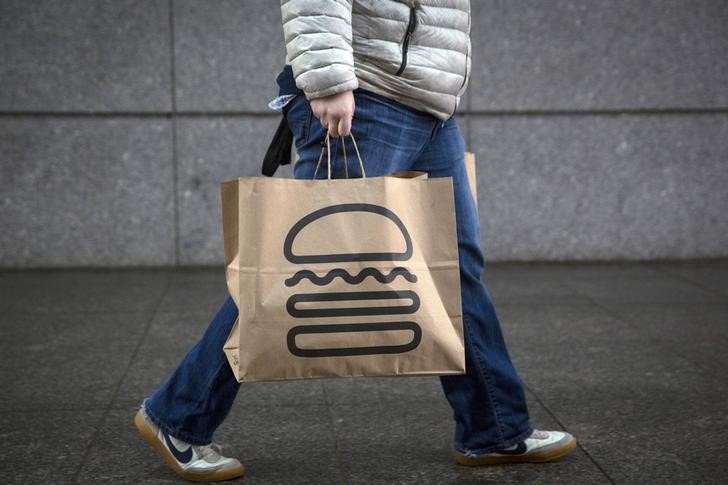
Stifel upgraded Shake Shack to Buy from Hold and called the post-earnings selloff excessive, even while cutting its price target to $85 from $105. The firm highlighted long-term margin expansion, cost discipline, and improving early-May traffic after the Smoky BBQ launch, while keeping Q2 same-store sales growth at 3.5%. The stock’s current valuation near 12.5x next-twelve-month EBITDA was cited as an attractive entry point, with upside tied to unit growth and future restaurant prototypes.
The setup is less about a clean fundamentals turnaround and more about valuation reset creating a reflexive tradeable bottom. When a consumer growth name gets de-rated into a decade-low multiple, the market is implicitly pricing a prolonged traffic and margin decay; any evidence that menu innovation can re-accelerate visits tends to produce outsized short-covering because positioning is usually already light. The key second-order effect is that smaller improvements in throughput and labor efficiency can matter more than same-store sales alone: if fixed-cost absorption improves, EBITDA can inflect faster than revenue, which is what typically drives the first leg of a re-rating.
The main loser here is not an obvious named competitor, but the broader premium fast-casual cohort that trades on growth scarcity. If the market starts rewarding SHAK for operational discipline instead of pure top-line growth, it can compress the relative premium of other high-multiple restaurant concepts with weaker unit economics or less credible path to margin expansion. A better prototype mix, especially drive-thru, also changes the growth algorithm: it lowers the need for dense urban foot-traffic dependence and could expand acceptable site economics in suburban markets, widening the addressable pool faster than consensus likely models.
The risk is that this is a months-long story, not a days-long one. Early traffic improvement tied to a new menu item can fade quickly if the consumer is trading down, promotional intensity rises, or commodity and wage pressure prevent margin capture from showing up in reported numbers by the next two quarters. The other tail risk is that investors confuse optionality on future store counts with near-term earnings power; if unit growth accelerates before returns on new formats are fully proven, valuation can stay depressed longer despite headline expansion.
Contrarianly, the market may be underestimating how much of the bad news is already in the stock. At roughly low-teens EBITDA, even modest confirmation of margin durability can re-rate the name by several turns over 6-12 months, while downside from here is more likely to be a multiple floor rather than a fresh collapse unless traffic deteriorates materially again. The cleaner expression is not an outright chase, but a staged entry that relies on earnings revisions stabilizing before the broader consumer group rotates back into growth.
AI-powered research, real-time alerts, and portfolio analytics for institutional investors.
Request DemoOverall Sentiment
mildly positive
Sentiment Score
0.25
Ticker Sentiment
